

SEO studies indicate that pages with multiple referring domains can see up to 40% better ranking potential and web 2.0 sites contribute by improving link diversity and contextual relevance.
When used strategically, they support trust signals and play a steady role in building domain authority.
At Bloggervoice, our data analyst has researched best web 2.0 sites and all are verified by our SEO experts.
In this blog we have discovered the list, meaning, benefits, mistakes that should be avoided and many more. So now let’s get started.
What Are Web 2.0 Sites?
Web 2.0 sites are user-generated content platforms where anyone can create a free blog, website or profile and publish content with links to their own website.
Unlike old static websites (Web 1.0), Web 2.0 platforms let users create, share and interact with content. Popular examples include:
- Blogging platforms: Blogger, WordPress.com, Medium, Tumblr
- Free website builders: Google Sites, Wix, Weebly, Jimdo, Strikingly
- Publishing and document sites: Issuu, Scribd, SlideShare
- Community and social platforms: Reddit, Quora, LiveJournal
In SEO, Web 2.0 submission means creating a mini-blog or site on these platforms, publishing helpful articles, and adding natural links back to your main website.
Publishing on free blog submission sites works in a similar way and helps you earn more contextual backlinks from trusted platforms.
What are Web 2.0 links? Web 2.0 links are backlinks you place inside your own content on Web 2.0 platforms, pointing back to your website. Because they sit inside real articles, search engines treat them as contextual links.
Top 10 Web 2.0 Submission Sites for 2026
Google Sites, Blogger, Wix, WordPress.com and Medium are the best Web 2.0 sites in 2026, thanks to their high DA, easy setup and contextual linking.
| Rank | Site | DA | Link Type | Best For |
|---|---|---|---|---|
| 1 | Google Sites | 97 | Usually dofollow | Simple mini-sites with fast indexing |
| 2 | Blogger | 95 | Usually dofollow | Full blogs with contextual links |
| 3 | Wix | 95 | Usually dofollow | Branded mini-websites |
| 4 | WordPress.com | 94 | Usually dofollow | Long-form niche blogs |
| 5 | Medium | 94 | Nofollow | Brand visibility and readers |
| 6 | Tumblr | 94 | Usually dofollow | Short posts and visual content |
| 7 | Weebly | 94 | Usually dofollow | Easy drag-and-drop sites |
| 8 | Substack | 92 | Mixed | Newsletters and articles |
| 9 | Jimdo | 92 | Usually dofollow | Small business mini-sites |
| 10 | Strikingly | 90 | Usually dofollow | One-page brand sites |
- Website builders like Google Sites, Wix and Weebly give you the most control over content and link placement.
- Medium is nofollow, but it still brings real readers, brand mentions and faster discovery.
- Start with 5 to 10 strong platforms and build them well, not hundreds of thin blogs.
List Of Web 2.0 Sites In 2026
Here is our full list of Web 2.0 sites for 2026, with DA scores from highest to lowest. Use this Web 2.0 list to pick platforms that match your niche.
| S.No. | Web 2.O Sites Name | DA |
|---|---|---|
| 1 | Sites.google.com | 97 |
| 2 | Blogger.com | 95 |
| 3 | Wix.com | 95 |
| 4 | reddit.com | 95 |
| 5 | vk.com | 95 |
| 6 | Wordpress.com | 94 |
| 7 | Medium.com | 94 |
| 8 | Tumblr.com | 94 |
| 9 | Weebly.com | 94 |
| 10 | Webstarts.com | 94 |
| 11 | Behance.net | 94 |
| 12 | my.opera.com | 94 |
| 13 | flickr.com | 94 |
| 14 | squarespace.com | 94 |
| 15 | discord.com | 94 |
| 16 | Behance.net | 94 |
| 17 | SoundCloud.com | 94 |
| 18 | Goodreads.com | 93 |
| 19 | Dribbble.com | 93 |
| 20 | Issuu.com | 93 |
| 21 | micro.blog | 93 |
| 22 | Xing.com | 92 |
| 23 | Evernote.com | 92 |
| 24 | Jimdo.com | 92 |
| 25 | Ghost.org | 92 |
| 26 | Substack.com | 92 |
| 27 | Slideshare.net | 92 |
| 28 | quora.com | 92 |
| 29 | Slashdot.org | 91 |
| 30 | Hubpages.com | 91 |
| 31 | Hatenablog.com | 91 |
| 32 | Deviantart.com | 91 |
| 33 | Calameo.com | 91 |
| 34 | Scribd.com | 91 |
| 35 | Pen.io | 90 |
| 36 | Webs.com | 90 |
| 37 | Strikingly.com | 90 |
| 38 | Blog.fc2.com | 90 |
| 39 | Hatena.ne.jp | 90 |
| 40 | MyStrikingly.com | 90 |
| 41 | ReverbNation.com | 90 |
| 42 | Site123.com | 88 |
| 43 | Ning.com | 88 |
| 44 | VefoBlog.net | 88 |
| 45 | VefoBlog.net | 88 |
| 46 | Instructables.com | 88 |
| 47 | SitePoint.com | 87 |
| 48 | Yola.com | 87 |
| 49 | Zoho.com | 86 |
| 50 | Livejournal.com | 86 |
| 51 | Wattpad.com | 86 |
| 52 | forums.macrumors.com | 86 |
| 53 | Webnode.com | 85 |
| 54 | Dreamwidth.org | 85 |
| 55 | Angelfire.lycos.com | 85 |
| 56 | Tripod.lycos.com | 85 |
| 57 | Wikidot.com | 85 |
| 58 | Typepad.com | 83 |
| 59 | foroactivo.com | 76 |
| 60 | nouw.com | 76 |
| 61 | apsense.com | 76 |
| 62 | stockhouse.com | 76 |
| 63 | PureVolume.com | 76 |
| 64 | elgg.org | 76 |
| 65 | coggle.it | 76 |
| 66 | FC2.com | 75 |
| 67 | fotki.com | 75 |
| 68 | careerkarma.com | 75 |
| 69 | postach.io | 75 |
| 70 | gaiaonline.com | 75 |
| 71 | diasporafoundation.org | 75 |
| 72 | Manifo.com | 74 |
| 73 | Website2.me | 74 |
| 74 | onmogul.com | 74 |
| 75 | twoday.net | 74 |
| 76 | hi5.com | 74 |
| 77 | stockhouse.com | 74 |
| 78 | edublogs.org | 74 |
| 79 | miarroba.com | 74 |
| 80 | cohostpodcasting.com | 73 |
| 81 | forums.somethingawful.com | 73 |
| 82 | thestudentroom.co.uk | 73 |
| 83 | Flazio.com | 72 |
| 84 | Emyspot.com | 72 |
| 85 | All4webs.com | 72 |
| 86 | tripoto.com | 72 |
| 87 | travellerspoint.com | 72 |
| 88 | uberant.com | 72 |
| 89 | travelblog.org | 72 |
| 90 | ipernity.com | 72 |
| 91 | Blogsome.com | 72 |
| 92 | Mmm.page | 72 |
| 93 | WebEden.co.uk | 71 |
| 94 | Dailystrength.org | 71 |
| 95 | 23hq.com | 71 |
| 96 | netlog.com | 71 |
| 97 | kazeo.com | 71 |
| 98 | Writeupcafe.com | 70 |
| 99 | Ampblogs.com | 70 |
| 100 | blog.yahoo.com | 70 |
| 101 | allvoices.com | 70 |
| 102 | bereal.com | 70 |
| 103 | mouthshut.com | 69 |
| 104 | skyrock.com | 69 |
| 105 | Tealfeed.com | 69 |
| 106 | Spruz.com | 68 |
| 107 | KiwiBox.com | 68 |
| 108 | 8b.com | 67 |
| 109 | Boards.ie | 67 |
| 110 | Blogspot.com | 66 |
| 111 | Jux.com | 66 |
| 112 | fanart-central.net | 66 |
| 113 | sportsblog.com | 65 |
| 114 | Doomby.com | 64 |
| 115 | kidblog.org | 64 |
| 116 | imfaceplate.com | 64 |
| 117 | spoutible.com | 64 |
| 118 | fanbase.app | 64 |
| 119 | pillowfort.social | 63 |
| 120 | Wallinside.com | 63 |
| 121 | SingSnap.com | 63 |
| 122 | diaryland.com | 62 |
| 123 | LightCMS.com | 62 |
| 124 | Ka-Blogs.com | 61 |
| 125 | 20minutes-blogs.fr | 61 |
| 126 | Inube.com | 60 |
| 127 | kooapps.com | 60 |
| 128 | FreeWebsite-Service.com | 59 |
| 129 | insanejournal.com | 59 |
| 130 | Hazblog.com | 58 |
| 131 | hivesocial.app | 57 |
| 132 | spill.com | 56 |
| 133 | JournalSpace.com | 56 |
| 134 | thoughts.com | 54 |
| 135 | mywapblog.com | 54 |
| 136 | hatena.com | 54 |
| 137 | wallinside.blog | 54 |
| 138 | peoople.app | 54 |
| 139 | vefblog.net | 52 |
| 140 | Blogigo.com | 49 |
| 141 | Wall.fm | 49 |
| 142 | trustcafe.io/en | 49 |
| 143 | IBotoolbox.com | 49 |
| 144 | Own-free-website.com | 46 |
| 145 | Sosblog.com | 46 |
| 146 | BlogSpace.fr | 45 |
| 147 | Sosblogs.com | 45 |
| 148 | PopTent.net | 44 |
| 149 | forum.melonland.net | 44 |
| 150 | Webjam2.com | 43 |
| 151 | yousaytoo.com | 42 |
- 40 sites have DA 90 or higher, including Google Sites, Blogger, Wix, WordPress.com and Medium.
- More than 130 sites have DA 50 or higher, so you have plenty of high-DA options.
- Lower-DA platforms are useful for link diversity and tier-2 linking, not as your main backlink source.
What Are SEO Benefits Of Using Web 2.0 Sites?
Web 2.0 submission sites play a vital role in SEO when used with a clear plan and support link building, content discovery and trust signals without forcing links or sounding salesy.
Search engines read web 2.0 sites as supporting assets that help them to understand context, relevance and authority around a main website.
1. Contextual backlinks and authority signals from Web 2.0 sites
Instead of footers or sidebars, web 2.0 websites allow you to place links inside real content instead of footers or sidebars.
These links are placed naturally within paragraphs which helps search engines to read these links as a contextual reference, not a random link drop.
Recent SEO studies shows that pages ranking on the first page often earn links from multiple referring domains rather than one strong source.
High DA web2.0 websites help fill this gap by adding controlled, topic-relevant links that support domain authority.
When you use varied anchor text across high da pa backlinking websites , search engines see a balanced link profile. This approach reduces over-reliance on exact match phrases and keeps link patterns clean.
2. Faster indexing for new content using Web 2.0 platforms
Search engines crawl Web 2.0 sites quite often so when you publish content on these platforms, crawlers usually find it faster than content on a new website with zero history.
This speed helps in two ways.
- Your web 2.0 content gets indexed quickly, which allows links inside it to get noticed sooner.
- Search engines crawl the link pointing on our main website helps to find new pages easily.
SEO data still shows that pages receiving internal or external links shortly after publishing tend to get indexed earlier.
Web 2.0 sites act as a bridge to this timing gap, mainly for new blogs, landing pages or niche posts that need early visibility.
3. Brand visibility and trust building through Web 2.0 sites
Web 2.0 submission sites give your brand a presence across multiple trusted websites on the SERP.
When users see the same brand name appear on blogs, publishing platforms and content hubs, it builds familiarity. Familiar brands feel safer to users, even if they do not click immediately.
Search engines also track brand mentions and linked references across the web.
Web2.0 submission sites help spread consistent brand visibility without aggressive promotion which supports trust building over time, which matters more now than ever.
To spread your brand across even more trusted websites, you can also list your business on directory submission sites.
4. Support for tiered link building strategies with Web 2.0 sites
High da Web 2.0 websites work well as second-layer support in tiered link building. Instead of pointing all links directly to your money pages, you can point some links to web 2.0 content that already links to your main website.
This structure helps spread link equity while keeping your core pages protected from risky link sources. SEO professionals still use this method because it adds distance between experimental links and primary assets.
Web 2.0 submission sites act as buffers and they absorb link juice, pass relevance and help maintain balance. When done cleanly, this approach supports steady growth instead of sudden spikes that raise red flags.
How to Use Web 2.0 Sites for Blog Submission?
Publishing on Web 2.0 sites is an important part of off-page SEO. To do it right, set up a complete blog on a high-DA platform, publish a helpful article, add one or two natural links to your website, and post regularly so the blog stays active.
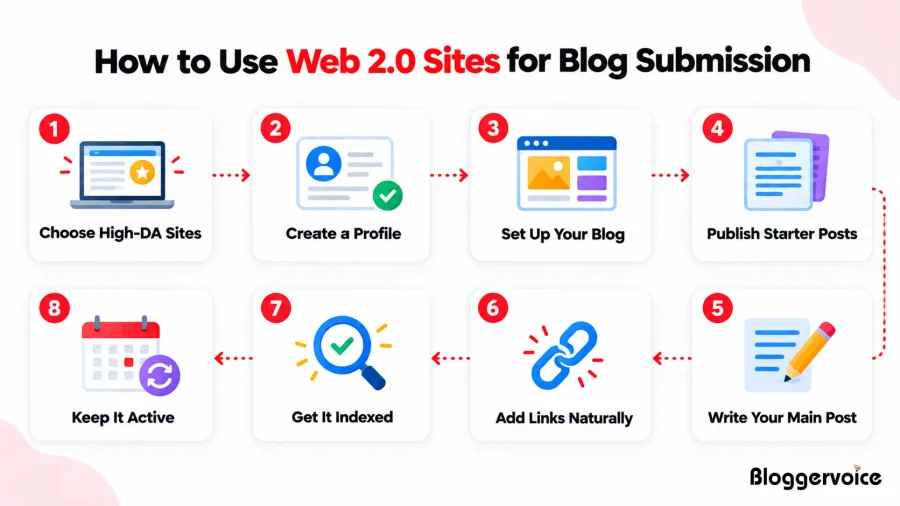
Step 1: Choose 5 to 10 High-DA Web 2.0 Sites
Start with trusted platforms like Blogger, WordPress.com, Google Sites, Tumblr and Medium. Pick sites that allow links inside posts and suit your niche. A few strong blogs work better than many weak ones.
Step 2: Create a Complete Profile
Sign up with a brand-related username, and add a profile photo, a short bio and your website link. Complete profiles look real to both readers and the platform, and they’re less likely to be removed.
Step 3: Set Up Your Blog
Choose a clean theme, give the blog a niche-related name, and add a short About page. Your Web 2.0 blog should look like a real website, not an empty page made only for links.
Step 4: Publish Starter Posts Without Links
Before adding any backlinks, publish 1 or 2 helpful posts on related topics. This makes the blog look active and builds some trust before your main post goes live.
Step 5: Write Your Main Post Using a Simple Template
Write a 700 to 1,000+ word article on a topic related to your website. Use this structure:
| Part | What to Write | Length |
|---|---|---|
| Title | A clear, keyword-based title, like “7 Easy Ways to Improve Local SEO” | 50 to 60 characters |
| Introduction | The problem and what the reader will learn | 2 to 3 short lines |
| Main tips | 3 to 5 tips under H2 or H3 headings | 500 to 800 words |
| Image | One relevant image with alt text | 1 image |
| Conclusion | A quick summary and a simple call to action | 2 to 3 lines |
Never post the same article on multiple Web 2.0 sites. Change the topic, wording and image for each platform.
Step 6: Add Links Naturally
Place 1 to 2 links inside the main content, in the first half of the post, using brand or natural anchor text.
| Do This | Avoid This |
|---|---|
| Add 1 to 2 links per post | Adding 5+ links in one post |
| Place links inside paragraphs | Putting links only in the footer or sidebar |
| Use brand names, URLs and natural phrases | Repeating the same exact-match keyword |
| Link to helpful posts and guides | Linking only to sales pages |
| Add 1 link to a trusted outside source | Linking only to your own website |
Step 7: Publish and Get the Post Indexed
Publish the post, share it on social media, and link to it from your other Web 2.0 blogs. After a few days, search the post title in Google to check that it’s indexed.
Step 8: Keep the Blog Active
Add a new post every 1 to 2 weeks, link your posts to each other, and update older posts every few months. Active blogs keep their value much longer than one-post blogs.
Treat every Web 2.0 blog like a small real website. The more useful and active it looks, the more value its links pass to your main site.
Building and managing Web 2.0 blogs takes time.
Why Search Engines Still Value Web 2.0 Sites In SEO?
Search engines focus on patterns, not just individual links. Web2.0 websites contribute to healthy patterns by adding diversity, context and content depth.
They show that a website earns references from different platforms rather than one narrow source.
Modern algorithms favor natural link environments and these kind of high da pa backlinking sites help create that environment when used with restraint and relevance.
Remember one thing that spam kills value but clean content keeps it alive.
When content answers real questions and links make sense within the topic, web2.0 websites remain useful SEO assets rather than shortcuts.
What Are The Common Mistakes To Avoid With Web 2.0 Submisson Sites?
Web 2.0 sites can help with SEO when used with care. Many site owners damage their rankings by rushing the process or copying outdated methods.
Search engines now mainly focus on the content patterns, intent and quality far better than before. If you want high authority backlinks and long term gains then you must avoid the mistakes given below.
1. Thin or spun content on Web 2.0 sites
Web 2.0 submission sites fail fast when content lacks depth that means short posts are rewritten using tools or spinning software leave clear footprints.
Search engines spot repeated sentence patterns, weak structure, and low topical coverage.
Recent content quality studies show that pages with clear topic depth and natural language perform better in search results.
When blogs publish thin posts on these websites they lose trust quickly and once the trust drops, links inside those posts lose value too.
To stay safe, write full articles that explain one topic clearly by adding real opinions, step based explanations and natural keyword placement.
Treat every blog content as a mini website, not a dumping ground because if a reader finds it boring then crawlers will feel the same.
2. Over optimized anchor texts in Web 2.0 backlinks
Over optimized anchors remain one of the most common SEO mistakes and repeating the same keyword rich anchor across multiple web 2.0 sites sends a clear warning signal.
Search engines prefer variety of natural anchors which include brand names, partial phrases, plain URLs and context based words.
Studies on backlink profiles still show that sites ranking well use mixed anchor styles rather than exact matches only.
If your goal includes dofollow backlinks and steady authority growth, keep anchor text balanced.
One web 2.0 link with an exact phrase is fine but ten with the same wording is risky.
3. Mass creation of Web 2.0 blogs
Creating dozens of web 2.0 blogs in a short time looks unnatural. Many people still follow old lists and publish ten blogs in one day but search engines track timing, velocity, and linking behavior and put this activity into spam.
Modern SEO favors steady growth but when many web 2.0 backlinks appear at once, crawlers question intent.
Instead of doing these kind of activities space your work and publish one or two web 2.0 blogs per week.
Add content slowly and let each blog age before adding links. This approach fits better with how real sites grow online.
If you aim to build high da pa backlinks, patience matters more than speed.
4. Ignoring profile optimization on Web 2.0 platforms
Many users skip profile setup and jump straight into posting links. That shortcut weakens trust signals. Profiles act as identity markers for web 2.0 platforms.
Search engines read profile completeness, bio text, images, and activity patterns. A blank profile with outbound links looks suspicious. A filled profile with real details looks natural.
Take time to add a profile photo, short bio, niche related keywords, and a website reference. This step supports trust and improves how platforms treat your content internally.
Small details often decide whether content stays live or gets removed.
5. Linking only to money pages from Web 2.0 sites
Linking only to sales pages raises red flags and real content rarely points straight to checkout pages every time.
Natural linking includes blog posts, guides, category pages, and brand pages.
Use web 2.0 blogs to support content assets. To do this link to informative posts first and then add one money page link only when context fits.
This method keeps your backlink profile safer and more realistic.
What Are The Best Practices For Web 2.0 Link Building?
Web 2.0 link building still works when done with care and common sense. The goal stays simple to create useful content, place links naturally and grow slowly.
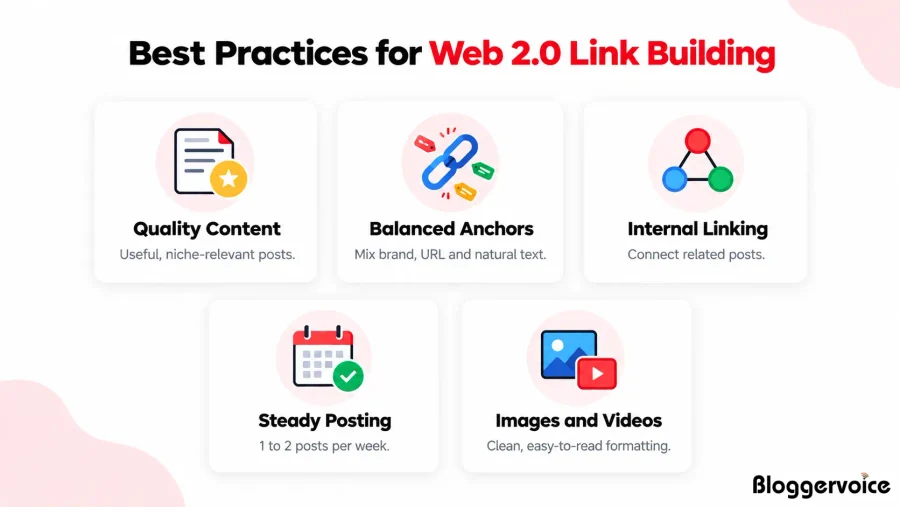
Below are the most effective practices that keep web 2.0 links safe and useful in 2026.
1. Creating high quality, niche relevant content
Start every web 2.0 blog with a clear topic connected to your main website. Search engines value relevance more than volume.
One well written article on a focused topic beats five random posts every time.
- Write content that explains, compares or solves a real problem in your niche.
- Use related terms and long tail phrases naturally across the article.
- Keep sentences clear and conversational.
- Aim for at least 700 to 1,000 words so the content feels complete, not rushed.
Treat each web 2.0 blog like a small authority site because when content looks helpful to readers, links inside it gain more trust.
2. Proper anchor text distribution in Web 2.0 links
Anchor text needs balance. Avoid repeating the same keyword across every web 2.0 site. Search engines expect variety and natural wording.
A healthy mix usually includes:
• Brand name anchors
• Partial keyword phrases
• Plain URLs
• Generic words like read more or visit site
Exact match anchors should stay limited and appear only when they fit the sentence naturally.
This approach keeps your backlink profile clean and avoids unnecessary risk.
3. Internal linking within Web 2.0 blogs
Internal links inside web 2.0 blogs improve structure and help search engines understand topic flow.
When you publish multiple posts on one web 2.0 site, link them together where relevant.
This practice keeps visitors engaged and spreads link value across page and also it makes the blog look active and real instead of a one post setup created only for backlinks.
Internal linking works best when each post covers a related subtopic instead of random subjects.
4. Posting frequency and content length
Consistency matters more than speed and publishing too many web 2.0 blogs at once can look unnatural.
One or two posts per week across different platforms looks realistic.
5. Using images, videos, and formatting
Visual elements improve content quality and user interest so add relevant images, screenshots, videos or simple charts where possible.
Formatting matters too that’s why break text into small paragraphs and use bold text for key points, also add bullet lists when explaining steps.
Clean formatting makes content easier to read and easier for crawlers to scan.
A well formatted post feels human and it separates useful web 2.0 content from spammy setups.
You can also turn your best Web 2.0 posts into short videos and upload them on video sharing platforms to reach a new audience.
How Do Web 2.0 Sites Compare to Other Link Building Methods?
Web 2.0 sites give you full control and easy contextual links, but guest posts usually pass more authority. The best results come from combining several methods.
| Method | Link Strength | Control | Cost | Best For |
|---|---|---|---|---|
| Web 2.0 sites | Medium | Full | Free | Contextual links and indexing |
| Guest posting | High | Low | Free to paid | Authority and referral traffic |
| Profile creation | Low | Medium | Free | Brand mentions and link diversity |
| Social bookmarking | Low | Medium | Free | Faster discovery of new pages |
| Classified submission | Low | Medium | Free | Local visibility and leads |
Web 2.0 sites work best as one part of a wider off-page SEO plan, not as your only backlink source.
Conclusion: Are Web 2.0 Sites Worth It in 2026?
Web 2.0 sites still hold value in SEO when used with planning, patience and quality content. They help in building link diversity, support faster discovery of new pages and strengthen trust signals around a main website.
When you publish useful content on high domain authority websites and place links naturally, search engines read those signals as genuine references rather than forced tactics.
At the same time, mistakes like thin content, repeated anchors, rushed blog creation, and poor profile setup can weaken results and waste effort.
Search engines now reward steady growth, clear intent and relevance over shortcuts.
Our SEO guide shows how Web 2.0 sites fit with other off-page SEO methods.
FAQs About Web 2.0 Sites
1. Are Web 2.0 link safe in 2026?
Yes, web 2.0 links are safe in 2026 when used with quality content, natural anchors, steady posting, and clear relevance.
2. Is Web 2.0 link building black hat SEO?
No. Web 2.0 link building is not black hat when your content is original and helpful, and your links are relevant and natural. It becomes risky only when it’s used for spam or automated mass posting.
3. Are Web 2.0 links dofollow or nofollow?
It depends on the platform. Blogger, WordPress.com, Google Sites, Wix and Weebly usually give dofollow links in posts, while Medium, Reddit and Quora use nofollow. Always check the link after publishing.
4. Which are the best free Web 2.0 sites?
The best free Web 2.0 sites include Google Sites, Blogger, Wix, WordPress.com, Medium, Tumblr, Weebly and Jimdo, all with DA above 90.
