

Blog submission sites are free platforms where you publish your articles or blog posts with a link back to your website.
Below is our list of 100+ free blog submission sites for 2026, with DA scores ranging from WordPress.com (DA 100), LinkedIn (DA 99) and Medium (DA 96) to smaller blogging communities.
The best free blog submission sites in 2026 are WordPress.com, LinkedIn Articles, Medium, Tumblr and Blogger. All five have DA 90+, give instant approval and are free to use.
BloggerVoice tested these blog posting sites to help bloggers, businesses and SEO beginners reach new readers, get pages indexed faster and build contextual backlinks the safe way.
List Of Free Blog Submission Sites In 2026
Here is our full list of free blog submission sites for 2026, with DA scores and link types. Use the filters to find dofollow or nofollow blog submission websites.
- More than 30 sites have DA 90 or higher, so you have plenty of high DA blog submission sites to start with.
- Website builders like Wix, Weebly and Strikingly work well for mini-blogs.
- A mix of dofollow and nofollow links looks the most natural to Google.
Top 10 Blog Submission Sites for 2026
WordPress.com, LinkedIn, Medium, Tumblr and Blogger are the best blog submission sites in 2026, thanks to their high DA, large audiences and easy publishing tools.
| Rank | Site | DA | Best For |
|---|---|---|---|
| 1 | WordPress.com | 100 | Full niche blogs with your own design |
| 2 | LinkedIn Articles | 99 | B2B, career and professional topics |
| 3 | Medium | 96 | Reaching an existing reader community |
| 4 | Tumblr | 94 | Short posts, images and quick sharing |
| 5 | Blogger | 92 | Free blogs with simple setup |
| 6 | DEV Community | 86 | Tech and developer content |
| 7 | Substack | 86 | Newsletters and long-form writing |
| 8 | HubPages | 82 | In-depth how-to articles |
| 9 | Vocal Media | 70 | Stories and creative writing |
| 10 | Write.as | 70 | Simple, distraction-free posts |
You can check the latest DA of any site with the free Moz Domain Analysis tool.
- WordPress.com and Blogger give you the most control, because you run your own blog.
- Medium and LinkedIn bring real readers, even when their links are nofollow.
- Niche communities like DEV Community send the most relevant traffic for their topic.
What Are Blog Submission Sites?
Blog submission sites are websites where you can create an account, publish a full blog post or article, and add links back to your own website.
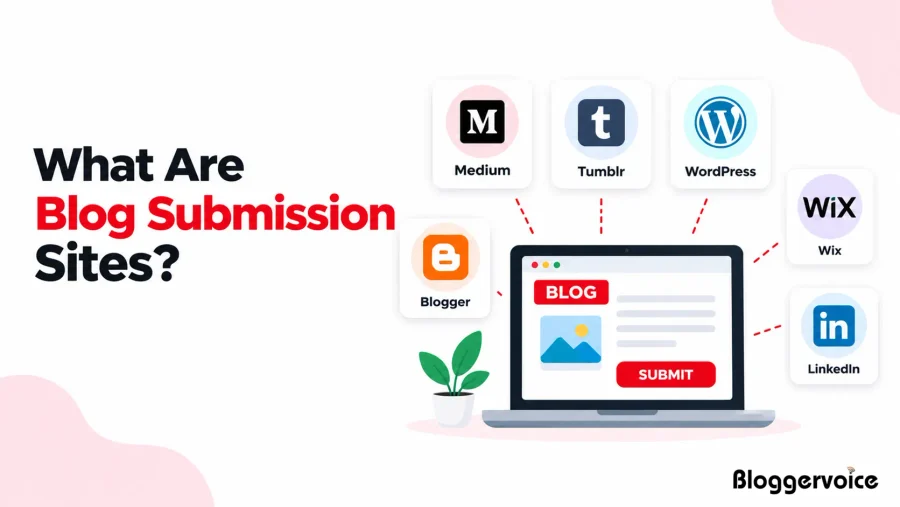
Some blog posting websites let you run your own mini-blog, like Blogger, WordPress.com and Tumblr. Others are publishing communities where your post reaches an existing audience, like Medium, LinkedIn Articles, Vocal Media and DEV Community.
Many of these platforms work like Web 2.0 sites, where you build your own mini-blog on a trusted domain.
In SEO, blog submission is an off-page technique. You share helpful content on trusted, high-DA platforms to earn brand mentions, referral traffic and contextual backlinks.
What Are the Types of Blog Submission Sites?
There are 4 main types of blog submission sites: blogging platforms, content communities, website builders and guest post blogs. Each type gives a different mix of control, readers and link value.
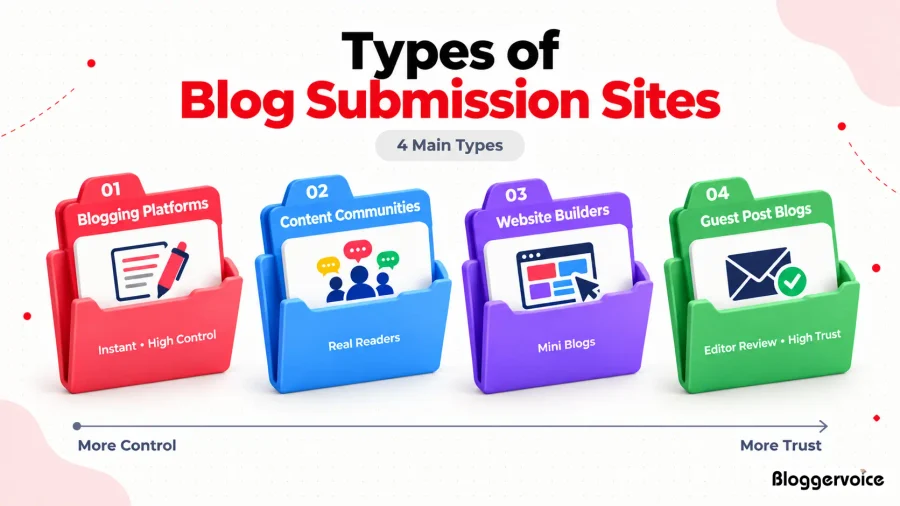
1. Blogging Platforms
Blogging platforms let you run your own free blog on a high-DA domain. WordPress.com, Blogger and Tumblr are the most popular. You control the design, posts and links.
2. Content Communities
Content communities publish your post in front of an existing reader base. Medium, LinkedIn Articles, DEV Community, HubPages and Vocal Media fit here. Links are often nofollow, but the traffic is real.
3. Website Builders
Website builders like Wix, Weebly and Strikingly let you create a small blog site for free. They work well for niche mini-blogs that support your main website.
4. Guest Post Blogs
Guest post blogs are real websites that accept articles from outside writers. Editors review every post, so approval takes longer, but the links carry more trust because they come from real niche sites.
| Type | Examples | Approval | Control | Best For |
|---|---|---|---|---|
| Blogging platforms | WordPress.com, Blogger, Tumblr | Instant | High | Building your own mini-blog |
| Content communities | Medium, LinkedIn, DEV Community | Instant or moderated | Medium | Reaching real readers |
| Website builders | Wix, Weebly, Strikingly | Instant | High | Niche support blogs |
| Guest post blogs | Niche industry blogs | Editor review | Low | High-trust contextual links |
Blogging platforms and website builders give you the most control, while guest post blogs give the strongest links. A good plan uses 2 to 3 types together, not just one.
Which Are the High DA Blog Submission Sites by Tier?
High DA blog submission sites fall into 3 tiers: DA 90+, DA 80–89 and DA 70–79. Start with Tier 1 for trust, then add Tier 2 and Tier 3 sites that match your niche.
Tier 1 Blog Submission Sites (DA 90+)
WordPress.com (100), LinkedIn Articles (99), Medium (96), Tumblr (94) and Blogger (92) are the strongest blog submission sites. They’re trusted by Google, get crawled often and suit every niche.
Tier 2 Blog Submission Sites (DA 80–89)
DEV Community (86), Substack (86) and HubPages (82) have strong authority and active reader communities. They work best for tech, newsletter and how-to content.
Tier 3 Blog Submission Sites (DA 70–79)
Vocal Media (70) and Write.as (70) are smaller but still trusted. They’re good for adding variety to your backlink profile and for creative or short-form posts.
| Tier | DA Range | Sites | Best Use |
|---|---|---|---|
| Tier 1 | 90+ | WordPress.com, LinkedIn, Medium, Tumblr, Blogger | Trust and fast indexing |
| Tier 2 | 80–89 | DEV Community, Substack, HubPages | Niche readers and authority |
| Tier 3 | 70–79 | Vocal Media, Write.as | Link diversity |
Relevance matters more than DA alone. A DA 86 tech community like DEV Community helps a tech blog more than a DA 94 general site. Sort the full table above by DA to find more sites in each tier.
Which Blog Submission Sites Give Dofollow Links?
Blogger, WordPress.com and Tumblr usually give dofollow links inside posts, while Medium, LinkedIn and DEV Community mostly use nofollow. Both link types are useful for SEO.
| Link Type | Sites | SEO Value |
|---|---|---|
| Usually dofollow | Blogger, WordPress.com, Tumblr | Passes link authority to your site |
| Mostly nofollow | Medium, LinkedIn Articles, DEV Community | Brings traffic, visibility and natural link diversity |
| Varies by post or plan | Substack, Write.as, HubPages | Check each live post |
How to Check if a Link Is Dofollow
- Open your published post in Chrome.
- Right-click your link and select Inspect.
- Look at the link code. If it has rel=”nofollow”, rel=”ugc” or rel=”sponsored”, it’s not dofollow. If none of these appear, it’s dofollow.
Sites that promise “100% dofollow links” are often spammy.
Google sees a natural mix of dofollow and nofollow links as normal, so don’t skip high-quality nofollow platforms like Medium and LinkedIn. This also applies when you look for dofollow article submission sites.
Which Blog Submission Sites Give Instant Approval?
WordPress.com, Blogger, Tumblr, Medium and LinkedIn give instant approval.
Your post goes live as soon as you publish it, and no editor reviews it first. Instant approval blog submission sites let you sign up, verify your email and publish on the same day.
That makes them the fastest way to get your content and brand link on a high-DA domain.
| Site | DA | Approval Time | Usual Link Type | Best For |
|---|---|---|---|---|
| WordPress.com | 100 | Instant | Dofollow | Full niche blogs |
| LinkedIn Articles | 99 | Instant | Nofollow | B2B and professional topics |
| Medium | 96 | Instant | Nofollow | Reaching an existing reader base |
| Tumblr | 94 | Instant | Dofollow | Short posts and image content |
| Blogger | 92 | Instant | Dofollow | Simple free blogs |
| DEV Community | 86 | Instant | Mostly nofollow | Tech and developer posts |
| Substack | 86 | Instant | Varies | Newsletters and long-form posts |
| Write.as | 70 | Instant | Varies | Quick, simple posts |
Key observation: All 8 instant approval sites have DA 70 or higher, and 5 of them have DA 90 or higher. Instant approval doesn’t mean a lower-quality site. HubPages and Vocal Media don’t appear here because they check every post for quality before it goes live.
How to Keep Your Posts Live on Instant Approval Sites
Instant approval sites publish your post at once, but their spam filters keep running in the background. A post can be published today and removed tomorrow. These steps help your posts stay live:
- Complete your profile first. Add a photo, a short bio and your website before your first post.
- Publish real content. Write at least 600 words of original, helpful text, not a thin post built around a link.
- Add only 1–2 links per post. Too many links on a new account often triggers spam filters.
- Don’t post links on day one. Publish one or two posts without links first, so the account builds some history.
- Avoid copy-paste content. Duplicate posts get removed more often and add little SEO value.
Instant approval sites are best for getting indexed fast, but long-term SEO results come from publishing consistent, quality posts on them.
What is The Difference Between Blog Submission Sites and Article Submission Sites?
Blog submission sites let you publish posts on blogs and blogging platforms, while article submission sites are directories that publish standalone informational articles. Both help you share content beyond your own website.
| Feature | Blog Submission Sites | Article Submission Sites |
|---|---|---|
| Where you publish | Blogging platforms and blog communities | Article directories and content hubs |
| Writing style | Conversational and flexible | Structured and informational |
| Control | You often run the blog yourself | Editors review and publish your article |
| Link value in 2026 | Higher, with contextual links | Lower; many directories are old or nofollow |
| Best for | Bloggers, brands and businesses | Writers sharing how-to articles |
Many of the top article submission sites, like HubPages and Medium, now work like blog platforms, so the two terms often overlap. If you’re looking for dofollow article submission sites, filter the table above by “Dofollow”.
How to Submit a Blog on Blog Submission Sites?
To submit a blog, pick a relevant platform, create a complete profile, publish a helpful original post, add one or two natural links, choose the right category and check that your post is live.
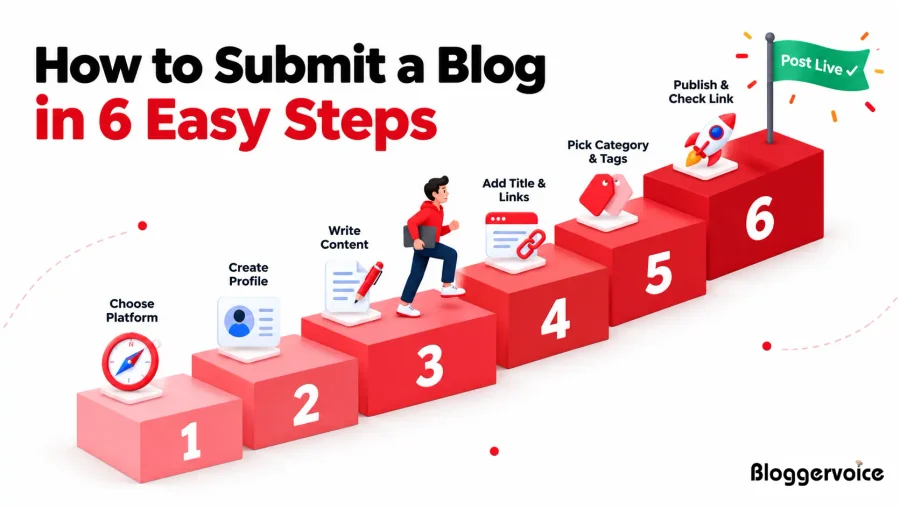
Step 1: Choose the Right Platform
Pick blog submission sites that match your niche and audience. A tech blog fits DEV Community, while a lifestyle blog fits Medium or Tumblr.
Step 2: Create a Complete Profile
Sign up with your brand name, and add a profile photo, a short bio and your website link. Complete profiles look trustworthy and are less likely to be removed.
Step 3: Write Original, Helpful Content
Write a 700 to 1,000+ word post that solves a real problem. Never copy a post from your own website word for word. Rewrite it or write a fresh angle.
Step 4: Add a Clear Title and Natural Links
Use a clear, keyword-based title, and add 1 or 2 links inside the content where they fit. Mix branded, partial-match and URL anchors.
Step 5: Pick the Right Category and Tags
Choose the closest category and 3 to 5 relevant tags, so the right readers find your post.
Step 6: Publish and Check Your Link
After you publish, open the post, click your link to make sure it works, and check whether it’s dofollow or nofollow.
Why Are Blog Submission Sites Important For SEO?
Blog submission sites help SEO through contextual backlinks, faster indexing, referral traffic and stronger brand visibility.
Here are other multiple reasons why blog submission sites are important:
1. Contextual Backlinks and Link Diversity
Blog posting sites let you place links inside real content, which search engines treat as natural references. A healthy mix of dofollow and nofollow links keeps your backlink profile natural.
2. Faster Indexing of New Pages
Search engines crawl popular blog platforms often, so links from them help Google and Bing discover your new pages sooner.
Sharing your new posts on social bookmarking sites can speed up discovery even more.
3. Referral Traffic From Real Readers
Platforms like Medium and LinkedIn have built-in audiences, so your post can bring visitors who are already interested in your topic.
4. Brand Visibility and Trust
Publishing on well-known blog sharing websites puts your name in front of new readers. Over time, this builds recognition and trust in your brand.
Adding branded graphics to your posts and sharing them on image submission sites builds this visibility further.
5. Support for a Long-Term SEO Plan
Blog submission works best alongside quality content and other off-page methods. It supports indexing, traffic and authority, but it doesn’t replace them.
What Is the Difference Between Free and Paid Blog Submission Sites?
Free blog submission sites let you publish at no cost, while paid platforms charge for guaranteed placement on established blogs.
| SEO Parameters | Free Blog Submission Sites | Paid Blog Submission Sites |
|---|---|---|
| Cost | No cost involved and ideal for tight budgets | Fixed submission or listing fee |
| Entry Barrier | Can submit blogs of any niche | Selective and approval-based submissions |
| Best For | New and early-stage blogging websites | Established and business-focused websites |
| Approval Speed | Slow due to manual queues or moderation delays | Fast or same-day approval |
| Editorial Control | Limited or inconsistent | Strong editorial and quality checks |
| Link Quality | Links can be DoFollow or NoFollow. It varies by site | Generally higher-quality Dofollow backlinks |
| SEO Impact | Helpful for indexing and link diversity. | Stronger authority and trust signals |
| Referral Traffic | Get a medium level of link juice. | High level and more targeted referral traffic. |
If you sell products or services, you can also promote your offers on free ad posting sites.
How To Choose The Right Blog Submission Sites?
Choosing the right article submission sites is very important in order to gain ranking and improving the authority.
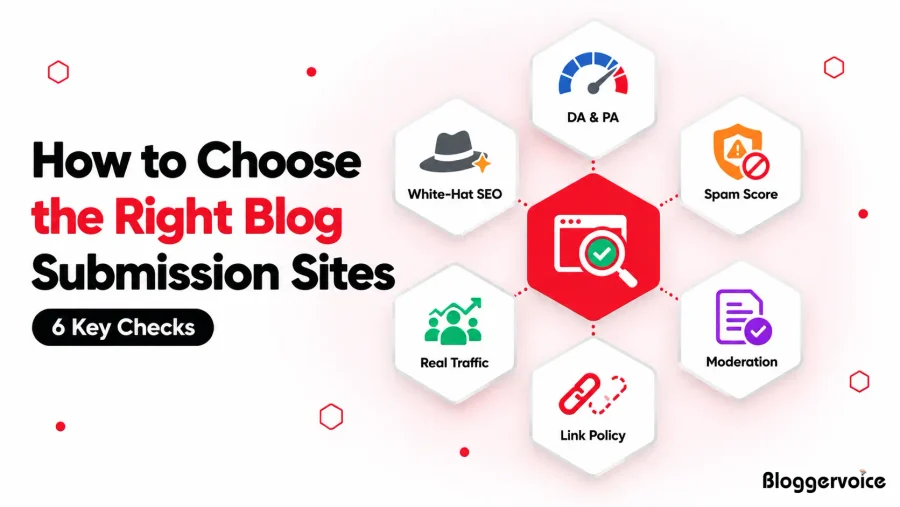
Here are the parameters that help you to choose the authoritive blog submission websites.
1. Domain Authority And Page Authority
Selecting a robust website with high Domain Authority (DA) and Page Authority (PA) is important for blog submission because it gives search engines more indications of trust.
Before publishing your content, you can assess authority metrics using tools like Moz, Ahrefs, or SEMrush.
2. Spam Score And Trust Signals
Avoid blog submission sites with high spam scores that include duplicated content, excessive ads, broken pages or unrelated outbound links.
It can hamper your website so badly that your website can be penalised by the search engines and in some time your ranking can drop down and you will lose profits.
A clean site structure, proper HTTPS setup, and consistent updates indicate stronger trustworthiness.
3. Moderation Quality And Content Relevance
Only relevant and unique content is published because of strict moderation.
In order to maintain SEO safety and ranking stability, well-moderated platforms shield your website from hazardous link neighbourhoods.
4. DoFollow V/S NoFollow Link Policy
Research out websites that provide a natural combination of DoFollow and NoFollow links.
Avoid clear of websites that solely offer DoFollow backlinks filled with keywords, as this indicates manipulation and raises the possibility of consequences.
5. Traffic Potential And Audience Relevance
Analyse whether real users interact with the information being presented.
Look for current contributions, social media sharing, comments, and category browsing.
Targeted referral traffic from an active audience delivers more SEO value than inflated authority numbers alone.
6. Long-Term SEO Compatibility
Select platforms that align with white-hat SEO practices and Google’s link quality guidelines.
A smaller list of high-quality blog posting sites will always outperform mass submissions on low-value platforms.
What Are The Best Practices For Blog Submission Websites?
Here are the best practices you can follow for blog submission to maximize SEO and visibility.
1. Write Content That Solves A Real Problem
Submit content that is actually helpful to the reader at all times, rather than content produced only for the purpose of placing backlinks.
Blog submission platforms reward content that provide readers with best actionable solutions, clear explanations of concepts or answers to particular enquiries.
Your content gains greater placement, extended visibility, and more trust equity when it adds value.
2. Maintain A Steady And Natural Submission Frequency
Search engines may find it strange if you post several links in brief blogs.
Maintaining a healthy backlink profile over time is facilitated by a constant and steady submission schedule that represents organic growth.
Quality and timing matter more than volume of link submission.
3. Use A Balanced Anchor Text Strategy
Instead of using exact-match keywords frequently, use mix branded, generic, and relevant anchor texts.
This method complies with Google’s link quality standards, looks natural, and shields your website from over-optimization hazards.
Anchor diversity also improves long-term ranking stability.
4. Link To Relevant And Useful Internal Pages
Point links to in-depth guides, category pages or resources, not only your homepage or sales pages.
Local businesses can also list their service pages on business listing sites for extra local visibility.
5. Track Every Submitted URL And Performance
Maintain a record of each and every blog submission which includes the domain name and submission date so that you can evaluate which sites deliver real SEO benefits.
You can monitor indexing status, referral traffic and backlink quality to identify high-performing sources.
This data-driven process helps redefine your submission strategy and you can avoid platforms that fail to generate results.
What Are The Common Mistakes To Avoid While Submitting Blog In Article Submission Websites?
The most common blog submission mistakes are copied content, keyword-stuffed anchors, spammy platforms, posting too fast and ignoring platform rules.
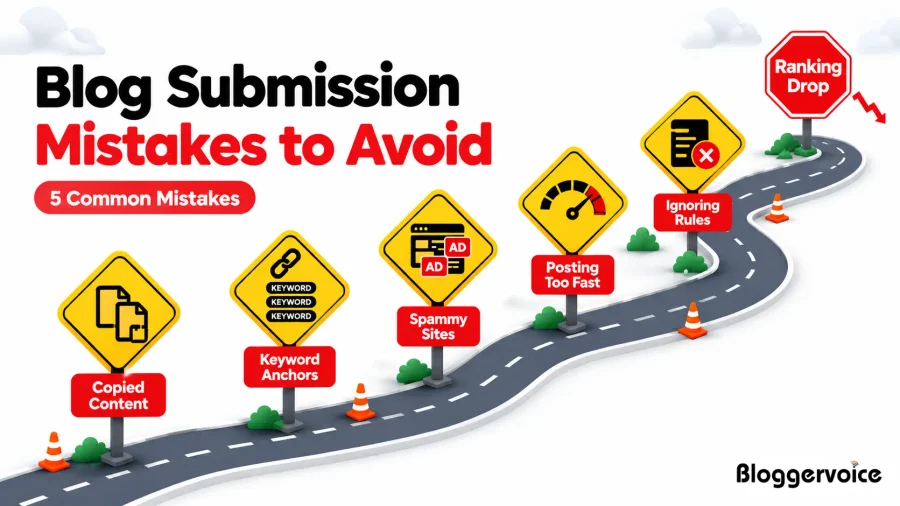
Here are the common mistakes that should be avoided at any cost while submitting the blog on a platform.
1. Submitting Copied Or Spun Content
Never send articles to article submission sites that are identical, scraped or slightly twisted as low-quality content is frequently rejected by these platforms and even if it is published, copied content can damage your brand’s reputation and search engine ranking.
2. Over-Optimizing Anchor Text With Keywords
Now search engines become extremely cautious when the same keyword-rich anchor text is used again and again.
Over-optimization and link penalties are the result of this strategy.
3. Relying On Low-Quality Or Spammy Platforms
Submitting material to websites that have too many advertisements, irrelevant links or inadequate moderation can lead to panelization by search engines rather than improve your SEO.
These sites might have a detrimental impact on your site’s trust signals because they are frequently part of malicious link networks.
4. Submitting Too Many Links In A Short Time
Posting lots of submissions in one day seems unnatural and manipulative.
Gradual link growth that mimics organic marketing is preferred by search engines.
Results are stronger and more long-lasting when the submission rate is steady and consistent.
5. Ignoring Editorial And Submission Guidelines
Each and every blog submission platform has their own certain formatting, category, and linking requirements.
If you don’t follow these guidelines, your content will often be rejected or deleted.
Long-term link stability is maintained and approval rates are increased by adhering to platform standards.
What Are The Pro & Cons Of Submitting Blog In Blog Submission Websites?
Blog submission sites are free and help with links, indexing and traffic, but they take time and some platforms are low quality.
Here are the main pros and cons of submitting blog in blog submission websites.
| Blog Submission Pros | Blog Submission Cons |
|---|---|
| Blog submission websites offer a budget-friendly way to build backlinks without heavy investment, making them suitable for startups and small websites. | The submission process requires manual effort and in certain times managing multiple platforms can become more hectic. |
| They help search engines like Google to discover new content faster, especially for fresh blogs or recently published pages. | Low-quality or spammy platforms can weaken trust signals and negatively affect SEO. |
| These platforms provide additional referral traffic from users browsing by category or topic interest. |
What Is The Future Of Blog Submission Websites In 2026?
Search platforms focus more on link relevance and editorial checks and Google Search Central continues to warn against manipulative link patterns.
Platforms now rely on smarter moderation tools to filter low-quality submissions.
Blog submission fits modern SEO when you follow white-hat methods. User-friendly content, credible platforms and strong relevance always remain essential.
If you are using your blog submission strategy wisely then it is still possible to rank and increase visibility of your webpages in 2026
Conclusion: Are Blog Submission Sites Worth It in 2026?
Yes, blog submission sites are still worth it in 2026 when you publish helpful, original content on trusted platforms.
Start with high-DA blog submission sites like WordPress.com, Medium, Blogger, Tumblr and LinkedIn, then add niche platforms that match your topic.
Write a unique post for every platform, mix your anchor text, publish at a steady pace, and check every link after it goes live. Used this way, blog submission brings real readers, faster indexing and safe contextual backlinks.
To see how blog submission fits with other off-page SEO methods, read our complete SEO guide.
FAQs About Blog Submission Sites
Where I Can Submit Blog Posts For Free As A Beginner?
There are many free blogging sites for beginners where you can submit your articles. They provide easy publishing tools, allowing new bloggers to share content and build online presence without technical knowledge such as blogger.com.
How To Submit Your Blog To Search Engines?
To submit your blog to search engines, first verify your website in tools like Google Search Console and Bing Webmaster Tools. Then submit your blog’s sitemap URL so search engines can crawl and index your pages faster, ensuring your content appears in search results more quickly.
Do Blog Submissions Still Work For SEO In 2026?
Yes, when used properly with high-quality, relevant content, blog submitting sites continue to support indexing, visibility, and referral traffic as part of a broader SEO strategy.
Can I Create A Simple Blog Website Before Submitting Blogs Elsewhere?
Yes, starting with a simple bloging website helps you to build original content and authority, which you can later submit or repurpose on article submitting sites for better reach.
Do blog submission sites give dofollow backlinks?
Some do. Blogger, WordPress.com and Tumblr usually give dofollow links in posts, while Medium and LinkedIn often use nofollow. Always check the link after publishing.
How many blog submission sites should I use?
Start with 5 to 10 trusted platforms and build them well. A few strong, active profiles are better than many thin posts.
