

WordPress ping sites help search engines and content aggregators discover your new blog posts faster.
Instant indexing and rapid crawling matter more than ever as competition grows across every niche in 2026.
When it is used strategically, ping services can speed up visibility, support off-page SEO and improve content distribution without complex technical work.
WordPress Ping List
| S.No. | Websites |
|---|---|
| 1 | http://blogsearch.google.com/ping/RPC2 |
| 2 | http://bblog.com/ping.php |
| 3 | http://bitacoras.net/ping |
| 4 | http://blog.goo.ne.jp/XMLRPC |
| 5 | http://blogdb.jp/xmlrpc |
| 6 | http://blogmatcher.com/u.php |
| 7 | http://bulkfeeds.net/rpc |
| 8 | http://coreblog.org/ping/ |
| 9 | http://mod-pubsub.org/kn_apps/blogchatt |
| 10 | http://www.lasermemory.com/lsrpc/ |
| 11 | http://ping.blo.gs/ |
| 12 | http://ping.bloggers.jp/rpc/ |
| 13 | http://ping.feedburner.com |
| 14 | http://ping.rootblog.com/rpc.php |
| 15 | http://pingoat.com/goat/RPC2 |
| 16 | http://rpc.blogbuzzmachine.com/RPC2 |
| 17 | http://rpc.blogrolling.com/pinger/ |
| 18 | http://rpc.pingomatic.com |
| 19 | http://rpc.weblogs.com/RPC2 |
| 20 | http://topicexchange.com/RPC2 |
| 21 | http://trackback.bakeinu.jp/bakeping.php |
| 22 | http://www.bitacoles.net/ping.php |
| 23 | http://www.blogoole.com/ping/ |
| 24 | http://www.blogpeople.net/servlet/weblogUpdates |
| 25 | http://www.blogshares.com/rpc.php |
| 26 | http://www.blogsnow.com/ping |
| 27 | http://www.blogstreet.com/xrbin/xmlrpc.cgi |
| 28 | http://www.mod-pubsub.org/kn_apps/blogchatter/ping.php |
| 29 | http://www.newsisfree.com/RPCCloud |
| 30 | http://www.newsisfree.com/xmlrpctest.php |
| 31 | http://www.snipsnap.org/RPC2 |
| 32 | http://www.weblogues.com/RPC/ |
| 33 | http://xmlrpc.blogg.de |
| 34 | http://rpc.pingomatic.com/ |
| 35 | http://services.newsgator.com/ngws/xmlrpcping.aspx |
| 36 | http://rpc.twingly.com |
| 37 | http://ping.syndic8.com/xmlrpc.php |
| 38 | http://blogsearch.google.us/ping/RPC2 |
| 39 | http://blogsearch.google.tw/ping/RPC2 |
| 40 | http://blogsearch.google.sk/ping/RPC2 |
| 41 | http://blogsearch.google.se/ping/RPC2 |
| 42 | http://blogsearch.google.ru/ping/RPC2 |
| 43 | http://blogsearch.google.ro/ping/RPC2 |
| 44 | http://blogsearch.google.pt/ping/RPC2 |
| 45 | http://blogsearch.google.pl/ping/RPC2 |
| 46 | http://blogsearch.google.nl/ping/RPC2 |
| 47 | http://blogsearch.google.lt/ping/RPC2 |
| 48 | http://blogsearch.google.jp/ping/RPC2 |
| 49 | http://blogsearch.google.it/ping/RPC2 |
| 50 | http://blogsearch.google.in/ping/RPC2 |
| 51 | http://blogsearch.google.ie/ping/RPC2 |
| 52 | http://blogsearch.google.hr/ping/RPC2 |
| 53 | http://blogsearch.google.gr/ping/RPC2 |
| 54 | http://blogsearch.google.fr/ping/RPC2 |
| 55 | http://zing.zingfast.com |
| 56 | http://zhuaxia.com/rpc/server.php |
| 57 | http://xping.pubsub.com/ping/ |
| 58 | http://www.zhuaxia.com/rpc/server.php |
| 59 | http://www.xianguo.com/xmlrpc/ping.php |
| 60 | http://www.weblogues.com |
| 61 | http://www.snipsnap.org |
| 62 | http://www.popdex.com/addsite.php |
| 63 | http://www.popdex.com |
| 64 | http://www.mod-pubsub.org/ping.php |
| 65 | http://www.lasermemory.com |
| 66 | http://www.imblogs.net/ping/ |
| 67 | http://www.holycowdude.com/rpc/ping/ |
| 68 | http://www.feedsky.com/api/RPC2 |
| 69 | http://www.catapings.com/ping.php |
| 70 | http://www.blogsdominicanos.com/ping/ |
| 71 | http://rpc.technorati.com/rpc/ping |
| 72 | http://rpc.blogcatalog.com/ |
| 73 | http://api.my.yahoo.com/RPC2 |
| 74 | http://api.my.yahoo.com/rss/ping |
| 75 | http://ping.feedburner.com/ |
| 76 | http://api.feedster.com/ping |
| 77 | http://rpc.icerocket.com:10080 |
| 78 | http://www.bloglines.com/ping |
| 79 | http://a2b.cc/setloc/bp.a2b |
| 80 | http://api.moreover.com/ping |
| 81 | http://api.moreover.com/RPC2 |
| 82 | http://api.my.yahoo.co.jp/RPC2 |
| 83 | http://api.my.yahoo.com/ping |
| 84 | http://audiorpc.weblogs.com/RPC2 |
| 85 | http://bitacoras.net/ping/ |
| 86 | http://blog.goo.ne.jp |
| 87 | http://blogdb.jp |
| 88 | http://blogdigger.com/RPC2 |
| 89 | http://blogoole.com/ping/ |
| 90 | http://blogoon.net/ping/ |
| 91 | http://blogpeople.net/ping |
| 92 | http://blogsearch.google.ae/ping/RPC2 |
| 93 | http://blogsearch.google.at/ping/RPC2 |
| 94 | http://blogsearch.google.be/ping/RPC2 |
| 95 | http://blogsearch.google.bg/ping/RPC2 |
| 96 | http://blogsearch.google.ca/ping/RPC2 |
| 97 | http://blogsearch.google.ch/ping/RPC2 |
| 98 | http://blogsearch.google.cl/ping/RPC2 |
| 99 | http://blogsearch.google.co.cr/ping/RPC2 |
| 100 | http://blogsearch.google.co.hu/ping/RPC2 |
| 101 | http://blogsearch.google.co.id/ping/RPC2 |
| 102 | http://blogsearch.google.co.il/ping/RPC2 |
| 103 | http://blogsearch.google.co.in/ping/RPC2 |
| 104 | http://blogsearch.google.co.it/ping/RPC2 |
| 105 | http://blogsearch.google.co.jp/ping/RPC2 |
| 106 | http://blogsearch.google.co.ma/ping/RPC2 |
| 107 | http://blogsearch.google.co.nz/ping/RPC2 |
| 108 | http://blogsearch.google.co.th/ping/RPC2 |
| 109 | http://blogsearch.google.co.uk/ping/RPC2 |
| 110 | http://blogsearch.google.co.ve/ping/RPC2 |
| 111 | http://blogsearch.google.co.za/ping/RPC2 |
| 112 | http://blogsearch.google.com.ar/ping/RPC2 |
| 113 | http://blogsearch.google.com.au/ping/RPC2 |
| 114 | http://blogsearch.google.com.br/ping/RPC2 |
| 115 | http://blogsearch.google.com.co/ping/RPC2 |
| 116 | http://blogsearch.google.com.do/ping/RPC2 |
| 117 | http://blogsearch.google.com.mx/ping/RPC2 |
| 118 | http://blogsearch.google.com.my/ping/RPC2 |
| 119 | http://blogsearch.google.com.pe/ping/RPC2 |
| 120 | http://blogsearch.google.com.sa/ping/RPC2 |
| 121 | http://blogsearch.google.com.sg/ping/RPC2 |
| 122 | http://blogsearch.google.com.tr/ping/RPC2 |
| 123 | http://blogsearch.google.com.tw/ping/RPC2 |
| 124 | http://blogsearch.google.com.ua/ping/RPC2 |
| 125 | http://blogsearch.google.com.uy/ping/RPC2 |
| 126 | http://blogsearch.google.com.vn/ping/RPC2 |
| 127 | http://blogsearch.google.de/ping/RPC2 |
| 128 | http://blogsearch.google.es/ping/RPC2 |
| 129 | http://blogsearch.google.fi/ping/RPC2 |
| 130 | http://blogsnow.com/ping |
| 131 | http://blogstreet.com/xrbin/xmlrpc.cgi |
| 132 | http://blogupdate.org/ping/ |
| 133 | http://effbot.org/rpc/ping.cgi |
| 134 | http://feedsky.com/api/RPC2 |
| 135 | http://holycowdude.com/rpc/ping/ |
| 136 | http://imblogs.net/ping/ |
| 137 | http://lasermemory.com/lsrpc/ |
| 138 | http://newsisfree.com/RPCCloud |
| 139 | http://packetmonster.net/xmlrpc.php |
| 140 | http://ping.amagle.com/ |
| 141 | http://ping.bitacoras.com |
| 142 | http://ping.blogg.de/ |
| 143 | http://ping.blogmura.jp/rpc/ |
| 144 | http://ping.blogoon.net/ |
| 145 | http://ping.blogs.yandex.ru/RPC2 |
| 146 | http://ping.cocolog-nifty.com/xmlrpc |
| 147 | http://ping.exblog.jp/xmlrpc |
| 148 | http://ping.fakapster.com/rpc |
| 149 | http://ping.fc2.com/ |
| 150 | http://ping.feeds.yahoo.com/RPC2/ |
| 151 | http://ping.kutsulog.net/ |
| 152 | http://ping.myblog.jp |
| 153 | http://ping.namaan.net/rpc |
| 154 | http://ping.snap.com/ping/RPC2 |
| 155 | http://ping.weblogalot.com/rpc.php |
| 156 | http://ping.weblogs.se/ |
| 157 | http://ping.wordblog.de/ |
| 158 | http://pinger.blogflux.com/rpc |
| 159 | http://pingoat.com/ |
| 160 | http://pingqueue.com/rpc/ |
| 161 | http://popdex.com/addsite.php |
| 162 | http://r.hatena.ne.jp/rpc |
| 163 | http://rcs.datashed.net |
| 164 | http://rcs.datashed.net/RPC2/ |
| 165 | http://rpc.bloggerei.de/ping/ |
| 166 | http://rpc.britblog.com/ |
| 167 | http://rpc.newsgator.com/ |
| 168 | http://rpc.reader.livedoor.com/ping |
| 169 | http://rpc.tailrank.com/feedburner/RPC2 |
| 170 | http://rpc.technorati.jp/rpc/ping |
| 171 | http://rpc.wpkeys.com |
| 172 | http://snipsnap.org/RPC2 |
| 173 | http://syndic8.com/xmlrpc.php |
| 174 | http://thingamablog.sourceforge.net/ping.php |
| 175 | http://topicexchange.com |
| 176 | http://wasalive.com/ping/ |
| 177 | http://weblogues.com/ping/ |
| 178 | http://weblogues.com/RPC/ |
| 179 | http://www.a2b.cc |
| 180 | http://www.a2b.cc/setloc/bp.a2b |
| 181 | http://www.blogdigger.com/RPC2 |
| 182 | http://www.blogoon.net/ping/ |
| 183 | http://www.blogpeople.net |
| 184 | http://www.blogroots.com |
| 185 | http://1470.net/api/ping |
| 186 | http://rpc.icerocket.com:10080/ |
| 187 | http://www.blogroots.com/tb_populi.blog?id=1 |
What Is Ping SEO?
Ping SEO is a method that indicates search engines when you publish or update a web page.
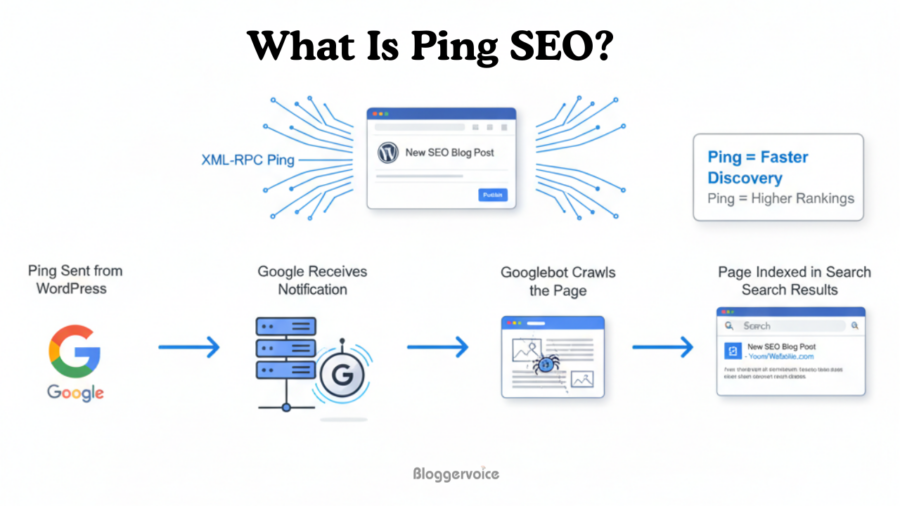
It uses XML-RPC technology built into WordPress, which sends your blog name and new URL to the update services listed in your dashboard when you publish it.
These pinging services act like messengers and inform feed readers, blog directories and search engine crawlers that fresh content is live.
Google states in its Search Central documentation that rankings depend on helpful content, relevance and quality link and not on ping notifications.
Ping SEO just speeds up content discovery and helps it to index more often, but it does not push your page to the top of search results.
What Are The Benefits Of Using A WordPress Ping List?
Here are the benefits of using a wordpress ping list:
- Faster Indexing Of Blog Posts
- Increased Crawl Frequency
- Improved Content Visibility
- Traffic Opportunities For New Websites
- Supporting Freshness Signals
1. Faster Indexing Of Blog Posts
Using a WordPress ping list helps search engines to notify immediately whenever you publish new content.
This helps your blog posts to get discovered and indexed much faster which reduces the waiting time for visibility in search results.
2. Increased Crawl Frequency
A ping list signals search engines that your website is active and regularly updated.
This indicates crawlers to visit your site more often to keep your content fresh in search engine databases.
3. Improved Content Visibility
By alerting multiple services simultaneously, pinging increases the chances of your content being noticed by search engines and RSS readers.
4. Traffic Opportunities For New Websites
New blogs often struggle to gain attention so using a ping list can accelerate discovery by search engines and directories and drive early traffic and help your website to establish authority.
5. Supporting Freshness Signals
Regular pings send consistent freshness prompting search engines that your site is actively maintained.
This can enhance your content’s ranking potential, especially for time-sensitive or trending topics.
How Ping SEO Works In WordPress?
Here are the step-by-step process of Ping SEO in WordPress.
Post is Published or Updated
WordPress triggers the update notification system automatically when you publish or modify a post.
Generate XML-RPC Request
The system creates an XML-RPC request to communicate your new content to external update services.
Send Ping to Update Services
Your blog details and RSS feed URL are sent to all configured ping servers instantly.
Ping Servers Receive Notification
Update directories record your latest content and mark your blog as recently updated.
Aggregators Forward the Update
Services like Ping-O-Matic distribute your update across multiple indexing platforms.
Search Engines Detect the Update
Search engine bots monitor these services and discover your newly published content.
Content Gets Crawled and Indexed
Your page is crawled, analyzed, and added to search results for faster visibility.
How To Verify If Your Post Is Indexed?
Here are steps to verify that your post is indexed:
site:yourdomain.com/post-url
Indexed or Needs Fix
How To Prevent Ping Spam In WordPress?
Prevent ping spam in WordPress by controlling how often your site sends update notifications to ping services.
WordPress triggers a ping every time when you publish or update a post, which can flood update servers if you edit repeatedly.
Excessive pinging may cause some services to ignore your site or flag it as spam.
Google Search Central confirms that crawling and indexing depend on content quality and crawl systems.
When you manage ping frequency wisely, you protect your domain reputation and keep your WordPress ping list clean and effective.
Why WordPress Pings On Every Update?
WordPress sends pings through XML-RPC each time you hit publish or click update on a post.
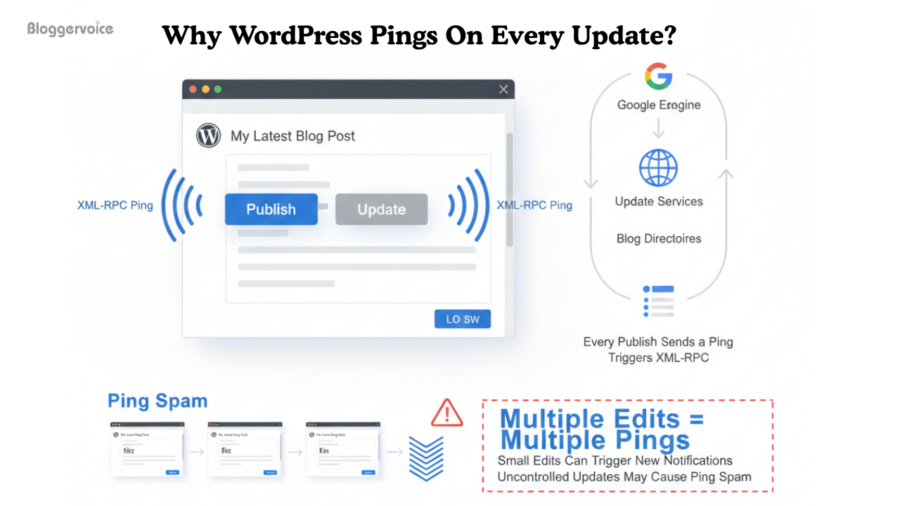
The system assumes every update could include new content that search engines should discover.
Even small edits like fixing a typo can trigger another ping notification and this behavior can create ping spam if you edit a post several times in a short period.
WordPress documentation explains that update services notify external servers automatically, which is helpful but needs control.
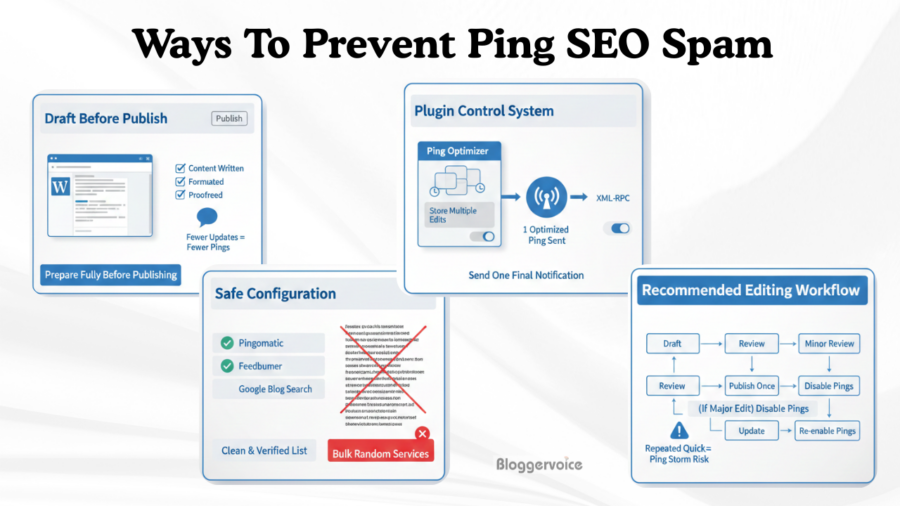
Here are the other ways to prevent Ping SEO spam:
- Controlling Ping Frequency
- Using Plugins To Limit Pings
- Best Safe Configuration Settings
- Recommended Workflow For Editing Posts
1. Controlling Ping Frequency
You can control ping frequency by limiting when WordPress sends notifications. One simple method involves preparing your article fully in draft mode before publishing it live.
When you avoid updating published posts multiple times, you reduce repeated pings to update services.
Some site owners remove all ping services temporarily while making large edits and add them back once the post is final.
This approach keeps your WordPress update service settings clean and prevents mass ping signals that look unnatural.
2. Using Plugins To Limit Pings
Several WordPress plugins help limit ping spam and manage XML-RPC notifications.
Plugins like “WordPress Ping Optimizer” store pending pings and send only one notification after you finish editing.
This method stops repeated alerts during multiple revisions. You can also disable XML-RPC partially through security plugins if you do not rely on remote publishing tools.
When you install a ping control plugin, check its last update date and compatibility with your WordPress version to avoid plugin conflicts.
3. Best Safe Configuration Settings
Keep your WordPress ping list short and verified instead of adding bulk ping sites from random blogs.
Add only trusted update services such as Pingomatic, which remains widely used in blogging communities.
Avoid mass ping tools that promise instant ranking boosts because search engines do not rank pages based on ping volume. Leave XML-RPC enabled only if you need it for publishing or update notifications.
A clean setup with limited services works better than a long spammy list that sends mixed signals.
4. Recommended Workflow For Editing Posts
Follow a structured workflow to prevent ping spam while keeping content fresh. Write and format your article in draft mode until it feels complete and polished.
Publish once, then review carefully before making any additional updates. If you need major revisions later, disable ping services temporarily, update the content, and then re-enable them after finishing.
This simple routine keeps your WordPress ping SEO strategy safe, avoids unnecessary ping storms, and saves your site from looking like it presses the panic button every five minutes.
Does Ping Website SEO Still Work In 2026?
Website owners often ask if pinging for SEO still works in 2026 so here in bloggervoice you will get your answer in a detailed way so that all your doubts about wordpress ping will get cleared.
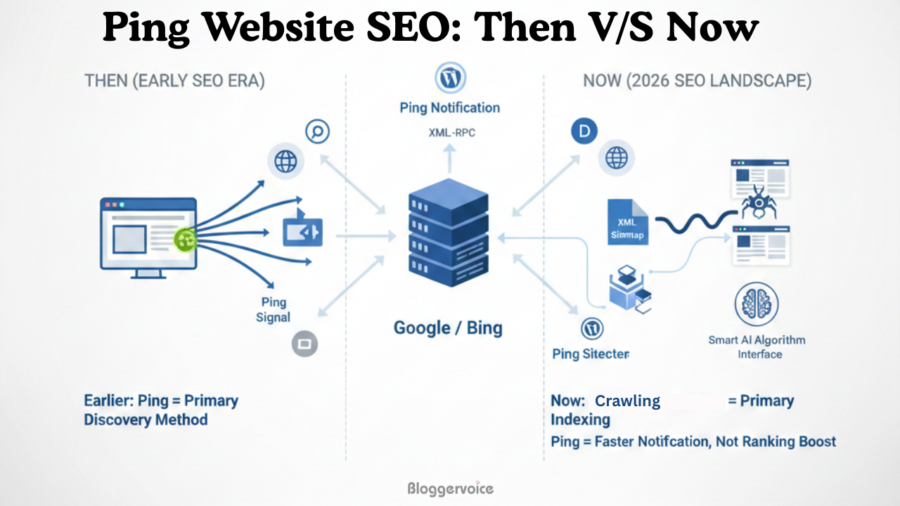
Ping services were once popular for notifying search engines about new or updated content. But the SEO landscape has changed with faster indexing tools and smarter algorithms.
Is Ping SEO Effective Today?
Pinging in SEO can still give signals to search engines that your content has been changed, but its impact on rankings is minimal.
Search Engines like Google or Bing are now relying more on structured sitemaps and crawling for indexing than on third-party ping requests.
Pinging may help smaller engines or niche directories notice updates faster. For major search engines, pinging is more of a speed booster than a ranking tool.
Let’s explore whether pinging still plays a role today and how it compares to modern alternatives.
1. Ping V/S Google Search Console
Submitting URLs directly to Google Search Console is far more reliable than using traditional ping services.
Search Console allows instant indexing requests for new pages or updated content, giving better control over how search discovers your site.
Ping services may still notify them indirectly, but the effect is slower and less predictable. If your goal is fast indexing then google search console is the smarter option.
2. Ping List V/S RSS Submission
| Basis | Ping List | RSS Submission |
|---|---|---|
| Definition | A ping list contains updated service URLs that WordPress notifies when you publish new content. | RSS submission involves submitting your RSS feed URL to directories or search tools. |
| How It Works | Your site sends an automatic XML-RPC notification to ping services after every new post. | You manually submit your RSS feed once and platforms pull new content from that feed. |
| Purpose | It alerts services instantly that new content is live. | IT distributes your content through feed readers and content syndication platforms. |
| Speed of Discovery | It works immediately after publishing if configured correctly. | It depends on how often the RSS directory checks your feed. |
| Control Level | It is managed inside WordPress update services settings. | It is managed by submitting and maintaining your RSS feed URL. |
| SEO Impact | It helps faster content discovery but does not improve rankings directly. | It supports visibility and referral traffic but does not guarantee ranking boosts. |
| Best Use Case | It is ideal for blogs that publish frequently and want quick indexing signals. | It is useful for content distribution, podcast feeds, and news-style websites. |
3. Ping V/S IndexNow
IndexNow is a modern replacement for ping SEO, supported by Bing or Yandex that instantly notifies search engines about content changes.
IndexNow offers verified API requests and higher success rates for immediate crawling.
It reduces the guesswork and removes the dependency on random ping directories.
4. Ping Services V/S Trackbacks
| Basis | Ping Services | Trackbacks |
|---|---|---|
| Definition | Ping services notify search engines about newly published content. | Trackbacks notify another blog that you linked to their content in your article. |
| Direction of Notification | It broadcasts to multiple update services. | It notifies a specific blog post. |
| Main Goal | It helps speed up search engine discovery of new URLs. | It creates connections between related blog posts. |
| Automation | WordPress sends pings automatically when you publish. | Trackbacks trigger when you link to another blog and their system accepts them. |
| SEO Value | It supports indexing speed but does not influence ranking factors directly. | It may create backlinks if approved, but many sites disable them due to spam. |
But now the questions is when pinging helps and when It Does Not?
Pinging helps when you want to alert smaller directories or blog networks quickly, especially if you post frequently.
It does not help if your main goal is Google rankings because Google prioritizes sitemaps and natural crawling signals over the third party pinging process.
Over-pinging can affect your website negatively as it looks spammy, so use it sparingly for specific use cases. Think of pinging as a gentle nudge, not a magic ranking shortcut.
What Are The Common Problems With WordPress Update Services?
Here are the most common problems faced with WordPress update services:
1. Overuse Of Bulk Ping Sites In WordPress Update Services
Overusing bulk ping sites is a common problem with WordPress update services.
When you send too many pings at once, search engines and ping servers may treat your site like spam.
Google’s spam policies warn against automated and repetitive submission tactics.
Keep your WordPress ping list short and relevant so your update signals look natural and trustworthy.
2. Dead Ping List Servers In WordPress Update Services
Dead ping list servers often break WordPress update services without showing clear errors.
Many outdated ping list 2026 URLs no longer respond, which slows down your publishing process.
When WordPress tries to contact inactive servers, it wastes time and server resources.
Review your ping list regularly and remove non-working URLs to keep your update services clean.
3. XML-RPC Security Risks In WordPress Update Services
XML-RPC supports WordPress update services, but it can expose your site to brute-force and pingback attacks.
Many hosting providers restrict XML-RPC because attackers target it frequently.
If your WordPress ping service stops working, your host may have limited XML-RPC access.
Secure it with a firewall or security plugin while allowing only the features you truly need.
4. Hosting Restrictions On WordPress Ping Services
Hosting restrictions can block WordPress update services when your site sends too many outbound requests.
Shared hosting providers often limit external connections to prevent abuse.
If your pings fail repeatedly, check with your hosting support team about rate limits.
Adjust your ping list and publishing habits to stay within hosting rules and avoid blocked notifications.
What Are The Best Practices For WordPress Ping List 2026?
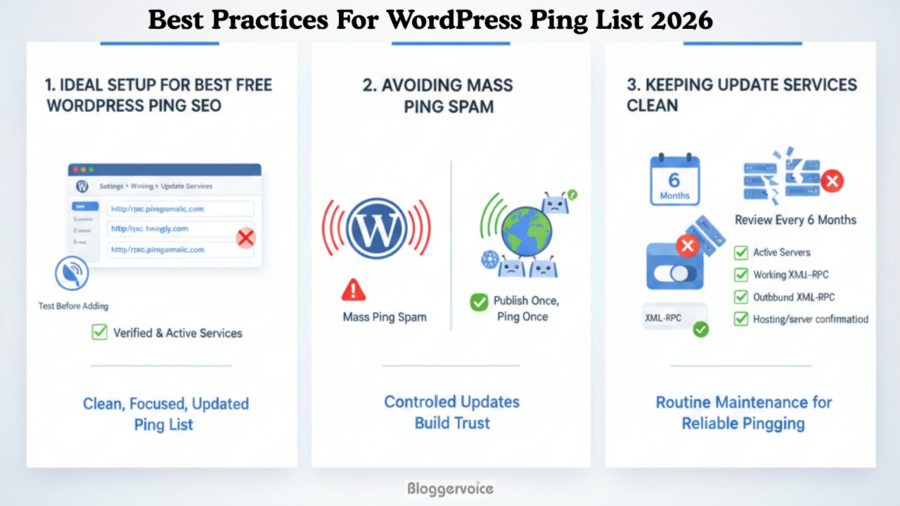
Here are the best practices for WordPress ping seo:
1. Ideal Setup For Best Free WordPress Ping SEO
The best free WordPress ping list works when you keep it clean and focused. Remove duplicate entries and avoid outdated servers that no longer respond.
Test each service before adding it to your WordPress update services settings.
A simple, updated ping list improves reliability and supports faster content discovery without overloading your hosting account.
2. Avoiding Mass Ping Spam In WordPress Update Services
Mass ping spam can damage the trust of your WordPress update services so always publish once and ping once instead of sending repeated signals after every small edit.
Search engines track unnatural update patterns, and repeated pings can trigger spam filters.
Plan your content carefully, finalize your post and then publish so your ping activity stays natural and controlled.
3. Keeping Your WordPress Update Services Clean
Keeping your WordPress updated services clean should be part of your routine maintenance.
Review your WordPress ping list in every six months and remove inactive or broken servers.
Check your XML-RPC settings and confirm your hosting provider to allow outbound ping requests.
A clean and updated ping list supports smooth publishing and protects your site from unnecessary technical issues.
What Security and Technical Considerations Should You Remember?
Security and technical considerations you should remember are as follows:
- Brute force login attempts
- Multiple password attempts in one request
- Server overload
(Ping services, mobile publishing, external tools)?
- Strong credentials
- Login protection plugin
- Firewall configuration
- Limit ping frequency
- Monitor hosting logs
Conclusion
The WordPress ping list helps search engines and update services to discover your newly published or updated content faster.
It improves indexing speed and crawlability but it does not help directly to improve the rankings of your website.
Google focuses on content quality, relevance, backlinks and overall site authority rather than just ping notifications.
Use a clean and verified WordPress ping list, control ping frequency and avoid mass ping spam to keep your site safe and efficient.
To improve rankings, combine pinging with blog submissions, business website submissions, PDF submissions, blog commenting and strong link-building strategies to build authority for long term SEO growth.
