

Brave browser reached 128.28 million monthly active users in September 2026, with about 53 million people using it every day.
Brave browser search engine, Brave Search, handled 2.63 billion queries that month, about 31 billion a year.
Brave browser statistics for 2026 show a privacy-first browser growing faster than ever.
In this blog, we share the latest Brave browser statistics on users, daily activity, search, revenue, funding, platforms, and how Brave compares with other browsers.
What Are the Key Brave Browser Statistics in 2026?
Brave has 128.28 million monthly active users, about 53 million daily users, and handles 2.63 billion searches a month as of September 2026.
Before we dive deeper, let’s take a quick look at the latest Brave Browser statistics.
| Metric | Brave Browser Figure | Source |
|---|---|---|
| Monthly active users (July 2026) | 122.6 million | Brave transparency page |
| Daily active users (July 2026) | 51.7 million | Brave transparency page |
| Daily search queries (peak, July 2026) | 81.6 million | Brave |
| Monthly search queries (July 2026) | 2.46 billion | Brave |
| Global browser market share | 0.95% to 1.2% | StatCounter, Cloudflare Radar |
| Total funding raised | $42.3 million | PitchBook, Crunchbase, Getlatka |
| 2025 estimated revenue | $100 million ARR | Getlatka (third-party estimate) |
| Employees | 190 | LinkedIn, PitchBook, Tracxn |
| Founded | 2015, by Brendan Eich and Brian Bondy | Wikipedia |
| Headquarters | San Francisco, California | Company records |
What Is Brave Browser?
Brave is a privacy-focused web browser built on Chromium, the same open-source engine behind Chrome and Edge.

Brave Browser was founded in 2015 by Brendan Eich, the creator of JavaScript and a co-founder of Mozilla, along with Brian Bondy.
The Brave browser blocks ads and trackers by default, which is the main reason people switch to it in the first place.
Brave also built its own search engine, Brave Search, after cutting ties with Microsoft’s Bing index in 2023, and it runs a rewards system built on a token called the Basic Attention Token, or BAT.
Brave Browser users who choose to view privacy-friendly ads can earn BAT rewards, which they can keep or use to support websites and content creators.
That mix of a fast, ad-blocking browser and a token-based rewards program is what sets Brave apart from other privacy browsers on the market.
| Detail | Brave Browser Information |
|---|---|
| Developer | Brave Software, Inc. |
| Founded | 2015, by Brendan Eich and Brian Bondy |
| First released | January 20, 2016 |
| CEO | Brendan Eich (creator of JavaScript, co-founder of Mozilla and Firefox) |
| Headquarters | San Francisco, California |
| Engine | Chromium |
| Platforms | Windows, macOS, Linux, Android, iOS |
| Key features | Brave Shields, Brave Search, Leo AI, Brave Wallet, Brave Rewards, Brave VPN |
| Latest stable version | 1.95.104 (September 18, 2026) |
How Many People Use Brave Browser Every Month and Every Day?
Brave had 128.28 million monthly active users in September 2026, up 1.6% from August, according to Brave CEO Brendan Eich.
That’s more than double the 61.2 million users Brave had in March 2024. User growth is where Brave’s numbers stand out most.
Brave Monthly Active Users Over Time
Brave browser reached 128.28 million monthly active users in September 2026, according to Brave CEO Brendan Eich.
Brave’s monthly users grew about 5 times in six years, from 25.4 million in 2020 to 128.28 million in September 2026.
| Date | Monthly active users |
|---|---|
| 2020 | 25.4 million |
| March 2024 | 61.20 million |
| April 2024 | 64.07 million |
| September 2025 | 100 million+ |
| December 2025 | 104.8 million |
| January 2026 | 109.4 million |
| March 2026 | 112.15 million |
| April 2026 | 115.26 million |
| May 2026 | 117.56 million |
| July 2026 | 122.6 million |
| August 2026 | 126.25 million |
| September 2026 | 128.28 million |
- Brave passed 100 million monthly users in September 2025 and added about 28 million more in the following 12 months.
- Brave added about 23 million monthly users in 2026 alone, from 104.8 million in December 2025 to 128.28 million in September.
- August 2026 was Brave’s fastest month of the year, with users up 3%.
How Many People Use Brave Every Day?
Brave averaged 54.60 million daily active users in September 2026, up 3.8% from August, its best daily-user growth of 2026.
| Date | Daily active users (28-day average) | Peak daily users |
|---|---|---|
| March 2024 | — | 25.79 million |
| April 2024 | 25.80 million | 27.15 million |
| December 2025 | 46.3 million | — |
| March 2026 | 45.42 million | 46.97 million |
| April 2026 | 47.01 million | 48.98 million |
| August 2026 | — | ~53 million |
| September 2026 | 52.97 million | 54.60 million |
- About 41% of Brave’s monthly users open it every day, a strong sign of habitual use.
- Brave’s peak daily users more than doubled in about two and a half years, from 25.79 million in March 2024 to 54.60 million in September 2026.
- Brave users spent a record 7.04 billion minutes a day in the browser in September 2026, up from 6.34 billion in March 2026.
What Do These Brave Browser User Stats Tell Us?
- Strong user growth: Brave’s MAUs increased from 109.6 million to 122.6 million, adding 13 million users (11.9%) in five months.
- Consistent growth momentum: Monthly user numbers increased steadily, suggesting sustained growth rather than a short-term spike.
- Stable daily engagement: DAUs stayed around 3.8–4.3 million throughout July, showing a consistent level of regular usage.
- Growing market reach: Crossing 120 million MAUs indicates that Brave is expanding beyond its original niche privacy-browser audience.
- Increasing monetization potential: A larger and consistently active user base creates more opportunities for Brave Search, Ads, Premium, and other services.
What Drove Brave’s Growth in 2026?
- Google I/O 2026: Brave saw a spike in new U.S. Android and iOS installs after Google’s I/O event in May 2026, and record new-user volume.
- The World Cup: a summer boost brought new users who kept using Brave after the tournament ended.
- Linux: Linux daily users more than doubled in the year to April 2026, making it Brave’s fastest-growing platform.
What is the Market Share of Brave Browser?
Brave Browser holds roughly 1% to 1.35% of the global web browser market share across all platforms.
Chrome dominates the global browser market with around 68% of the market.
However, Brave Browser’s exact market share is difficult to measure because Brave identifies itself as Chrome to websites to help protect users from tracking.
| Browser | Global Market Share (2026) |
|---|---|
| Google Chrome | 68% |
| Apple Safari | 18.1% |
| Microsoft Edge | 5.4% |
| Mozilla Firefox | 2.9% |
| Opera | 2.4% |
| Samsung Internet | 2.3% |
| Brave Browser | 1%–1.35% |
As a result, tools such as StatCounter may count some Brave users as Chrome users.
Brave’s own active-user counts look big, yet its share of overall web traffic stays small next to Chrome.
Source: Statcounter
What Is Brave’s Market Share Really Telling Us?
- Small market share: Brave’s ~0.95%–1.2% share remains tiny compared with Chrome, Safari and Edge, despite having 120M+ monthly active users.
- Strong niche position: The gap suggests Brave has built a large user base without yet translating that scale into equivalent share of global web traffic.
- Room to grow: Even a modest increase in market share could represent millions of additional users and substantially greater monetization potential.
- Overall: Brave’s position is best described as a fast-growing challenger with meaningful scale, but still a very small share of the overall browser market.
How Many Searches Does Brave Browser Handle Daily, Monthly, and Annually?
In 2026, Brave Search handles around 2.63 billion searches per month, which works out to roughly 87.7 million searches per day and approximately 31.6 billion searches per year.
These figures highlight the growing use of Brave Search as an alternative to traditional search engines.
| Metric | Figure (2026) |
|---|---|
| Peak daily queries | 81.6 million (July 6, 2026) |
| 28-day average daily queries | 79.3 million |
| Monthly queries (September 2026) | 2.63 billion |
| Average daily queries (September 2026) | 87.7 million |
| Annualized queries (from September 2026 pace) | ~31.6 billion |
| September 2025 monthly queries (for comparison) | Over 1.6 billion |
Source: Brave Transparency
What These Brave Search Numbers Are Pointing To?
- Search is becoming a major growth engine: At 2.46B monthly queries, Brave Search has moved well beyond being a browser add-on and is becoming a meaningful standalone product; Brave itself now reports 2.4B+ monthly queries and 80M+ daily queries, and comparisons such as how many users Perplexity has show how rapidly the broader search market is expanding around AI-powered alternatives.
- Momentum is accelerating: Compared with 1.6B+ monthly queries in September 2025, July 2026 represents roughly 54% growth, suggesting Brave is gaining search usage considerably faster than its browser market share alone would imply.
- Users are becoming more deeply engaged: With 122.6M MAUs and 51.7M DAUs in July, the combination of a large browser audience and ~80M daily searches suggests Brave is increasingly building an integrated browser + search ecosystem, rather than relying solely on browser adoption.
- My outlook: If Brave sustains anything close to this search growth, 30B+ annual queries is a realistic near-term milestone, while continued browser growth could make Search increasingly important to Brave’s advertising, AI, and API businesses. This is an extrapolation, not a company forecast; Brave is already positioning Search as infrastructure for AI applications through its independent search index and API.
How Many Downloads Does Brave Browser Have Across Different Platforms?
The Brave Browser Android app has surpassed 192 million Google Play downloads, and iOS has recorded 32 million total App Store downloads.
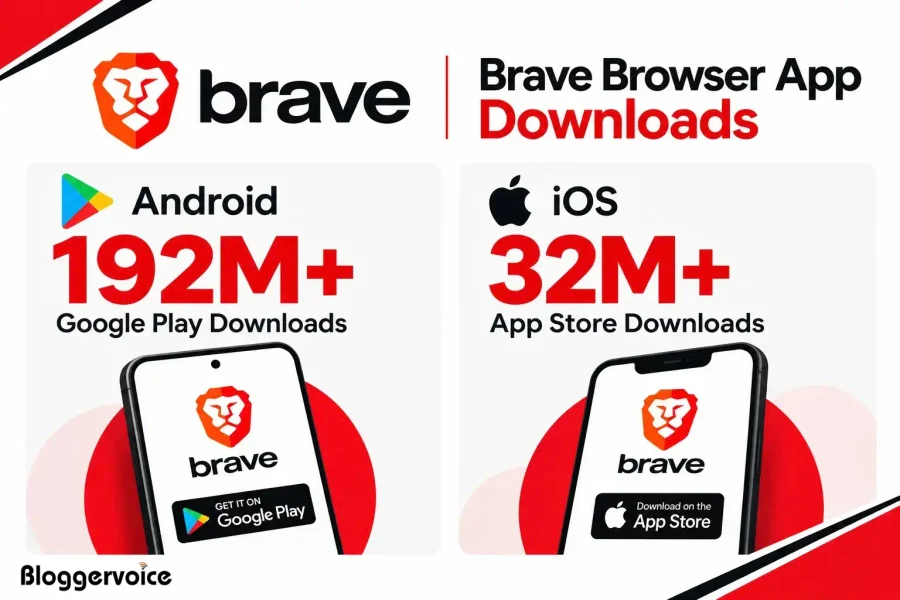
Brave Browser is available on Android, iOS, Windows, macOS, and Linux, with Android and iOS providing the clearest publicly available download figures.
| Platform | Publicly available download figure | What we can say |
|---|---|---|
| Android | 190M+ Google Play downloads | Largest publicly visible platform-level download milestone |
| iOS / iPadOS | 32M total downloads | Brave reports 32M total App Store downloads |
| Windows | Not publicly disclosed | Brave reports Windows downloads internally but does not publish a cumulative figure |
| macOS | Not publicly disclosed | Included in Brave’s desktop download/usage measurement, but no cumulative public total |
| Linux | Not publicly disclosed | Available across supported Linux distributions, but no public cumulative download count |
| All platforms | 120M+ monthly active users | Brave’s latest reported MAU across desktop and mobile, September 2026: 128.3M. |
Brave does not publicly disclose cumulative download totals for Windows, macOS, or Linux, so overall adoption is better represented by its monthly and daily active user figures.
What Do These Brave Browser Download Statistics Tell Us?
- Android is clearly a major distribution channel: Google Play alone shows 190M+ downloads, demonstrating substantial mobile adoption.
- iOS has meaningful scale too: Brave reports 32M App Store downloads, giving it a substantial Apple-device footprint.
- Desktop is harder to quantify: Windows, macOS and Linux downloads aren’t publicly broken out, so we should not estimate platform shares from the MAU figure without additional data.
- Overall adoption is much larger than download counts alone suggest: Brave reached 122.6M MAUs in July 2026, meaning the key business metric is now active usage and retention rather than raw downloads.
Analyst takeaway: The available evidence points to a mobile-heavy acquisition story, particularly on Android, combined with a significant desktop user base.
How Much Revenue and Funding Does Brave Have?
Brave has raised between $252 million and $359.6 million, depending on the source, and was last valued at $980 million in February 2022.
Brave revenue grew from about $20 million in 2022 to an estimated $100 million+ in annualized revenue by 2025–2026.
| Metric | Figure | Source |
|---|---|---|
| Total funding raised | $252M–$359.6M | Sacra, Getlatka |
| 2017 BAT token sale | ~$35M | Brave |
| Series A-7 (February 2022) | ~$50M | Sacra |
| 2022 valuation | $980M | Sacra |
| 2022 revenue | ~$20M | Sacra |
| 2023 revenue | ~$26M–$30M | Sacra |
| 2024 revenue | ~$52M | Industry estimate |
| 2025–2026 annualized revenue | $100M+ (estimate) | Industry estimate |
- Brave’s estimated revenue grew about five times, from ~$20 million in 2022 to $100 million+ in annualized revenue by 2025–2026.
- Brave’s revenue roughly doubled from 2023 to 2024, from ~$26–30 million to ~$52 million.
- Brave hasn’t announced a new valuation since 2022, so its $980 million valuation is likely well below its current worth.
How Does Brave Browser Make Money?
Brave Browser generates revenue through Brave Ads, Brave Search Ads, premium subscriptions, Search API services, Brave Wallet fees, and commercial partnerships.
This diversified model allows Brave to earn money from both individual users and businesses while keeping privacy at the center of its products.
| Revenue Source | How It Works |
|---|---|
| Brave Ads | Privacy-focused, opt-in ads shown within Brave Browser |
| Brave Search Ads | Ads displayed alongside Brave Search results |
| Search API | Businesses and developers pay for access to Brave’s search index |
| Premium subscriptions | Products such as Brave VPN, Brave Talk Premium, and other premium services |
| Brave Origin | Paid minimalist version of Brave Browser |
| Brave Wallet | Revenue from transaction and on-ramp fees |
| Partnerships | Commercial partnerships and Web3 integrations |
Who Uses Brave Browser?
Brave’s own audience surveys (roughly 4,000 respondents) paint a picture of a younger, more male-skewing user base than the browser market as a whole:
- Gender: Around 88% of surveyed users identify as male, with other third-party estimates putting the figure closer to 68% to 75% male when measured differently.
- Age: 31% are 18 to 24, 23% are 25 to 34, and 21% are 35 to 49, so more than half of Brave’s audience sits under 35.
- Occupation: About 40% are students, 29% work full-time, and 23% describe themselves as self-employed or running their own business.
- Household income: Close to 46% report household income under $30,000, which lines up with the large student share of the user base.
- Top countries: The United States leads Brave’s traffic at roughly 37%, followed by France, India, Germany, and the United Kingdom.
Source: Brave
Like Brave, Grokipedia is a fast-growing alternative to a long-established leader. Learn more about its user base in our Grokipedia statistics.
How Does Brave Browser Compare With Its Competitors?
Brave Browser has a 1%–1.5% global market share and 122.6 million monthly active users, compared with Firefox’s 2.9% market share and 362 million+ users.
This comparison highlights how Brave stacks up against two privacy-focused competitors, revealing its growing user scale, independent search ecosystem, and distinctive approach to privacy and monetization.
| Metric | Brave | Firefox | DuckDuckGo |
|---|---|---|---|
| Global browser market share | ~1%–1.5% | 2.9% | 0.38% (browser); wider reach via search app |
| Monthly active users/search volume | 122.6 million MAU | 362 million+ users (third-party estimate) | ~370 million monthly active users (third-party estimate) |
| Monthly search queries | 2.46 billion (Brave Search) | Uses Google by default | ~3 billion |
| Funding raised | 178M–314M plus $35M token sale | Backed by Mozilla Foundation, not VC-funded in the same way | $113 million across 3 rounds |
| Core differentiator | Built-in ad/tracker blocking, own search index, BAT rewards | Open-source, non-profit-linked mission | Ad-supported but non-tracking search |
Brave’s biggest edge over Firefox and DuckDuckGo is that it owns both the browser and the search engine behind it, giving it a position that fits into the wider growth seen across chatbot usage statistics and AI-powered digital services.
Firefox still has a bigger installed base by some measures, but its share has fallen for over a decade, down from over 32% in 2009 to under 3% by 2026.
DuckDuckGo, meanwhile, remains mostly a search product with a smaller standalone browser footprint, which puts Brave in an odd middle position: bigger than DuckDuckGo as a browser, smaller than Firefox in raw market share, but growing faster than either one in percentage terms.
What Are the Key Brave Updates in 2026?
A few 2026 updates help explain Brave’s current growth curve:
- January 2026: Brave reached 109.4 million monthly users.
- April 2026: daily users and daily searches hit all-time highs, and Linux daily users had more than doubled in a year.
- May 2026: Brave passed 117 million monthly users, with record new-user volume after Google I/O.
- June 2026: Brave launched Brave Origin, a minimal browser with Brave’s privacy protections but without rewards or crypto features.
- July 2026: News Corp countersued Brave, alleging it scraped and resold its articles to AI companies.
- August 2026: Brave reached 126.25 million monthly users, its fastest growth month of 2026, and Brave Search passed 2.5 billion monthly queries.
- September 2026: Brave reached 128.28 million monthly users, record daily usage of 7.04 billion minutes, and a record 88.48 million searches in one day.
Conclusion: What Do Brave Browser Statistics Tell Us in 2026?
Brave browser statistics for 2026 show steady, fast growth for the leading privacy browser.
Brave reached 128.28 million monthly users in September 2026, about five times its 2020 level, and about 41% of them use it every day.
Brave Search is growing even faster, with 2.63 billion monthly searches and a growing business selling search data to AI companies.
With $252 million raised and new revenue from AI search APIs, Brave is building one of the few real alternatives to Google in both browsing and search. We’ll keep updating these Brave browser statistics every month as new data comes in.
FAQs About Brave Browser Statistics
How Many People Use Brave Browser In 2026?
Brave had 128.28 million monthly active users and about 53 million daily active users in September 2026, according to Brave CEO Brendan Eich.
What Is Brave’s Market Share?
Brave holds roughly 1% to 1.5 % of global browser traffic, per StatCounter and Cloudflare Radar, well behind Chrome’s 65% share but ahead of smaller privacy browsers.
How Much Money Has Brave Raised?
Estimates range from $178 million (PitchBook) to $314 million (Getlatka) in venture funding, plus a separate $35 million token sale for the Basic Attention Token in 2017.
Is Brave Browser Profitable?
Brave does not publish audited financials. Third-party estimates put 2025 revenue at roughly $100 million in annual recurring revenue, up from about $52 million in 2024, though these figures come from outside analysts rather than the company itself.
How Many Searches Does Brave Search Handle?
Brave Search processed about 2.46 billion queries in July 2026, with daily volume peaking at 81.6 million queries, according to Brave’s own reporting.
Who owns Brave browser?
Brave is developed by Brave Software, Inc., a private company co-founded in 2015 by Brendan Eich, the creator of JavaScript, and Brian Bondy.
