
Notion statistics paint a picture of one of the leanest, fastest-growing companies in productivity software.
In 2026, Notion serves 100 million+ users, pulls in an estimated $865 million in annual recurring revenue, and carries an $11 billion valuation while running on a team most people would call small.
This article covers the latest Notion stats on users, money, headcount, and market position, and then explains what those numbers actually mean.
What Are Notion’s Key Stats at a Glance?
Here are Notion’s key 2026 numbers, from Sacra, CNBC, Forbes, and Notion itself.
| Metric | 2026 Figure |
|---|---|
| Total users | 100 million+ (across 85+ countries) |
| Paying customers | 4 million+ |
| Annual recurring revenue | $865 million (Sacra, July 2026) |
| Revenue growth | ~82% year over year |
| Valuation | $11 billion (2026) |
| Total primary funding | $344 million |
| Core employees | 1,000 (associated headcount runs higher) |
| AI-enabled share of ARR | 50%+ |
| Fortune 500 adoption | 50%+ (some trackers cite ~75%) |
| Users outside the US | ~80% |
| Templates in marketplace | 30,000+ |
Source: Sacra
How Has Notion’s Revenue and Funding Grown Over Time?
Since 2013, Notion has gone from zero revenue to a company valued at $11 billion, and the growth curve tells its own story.
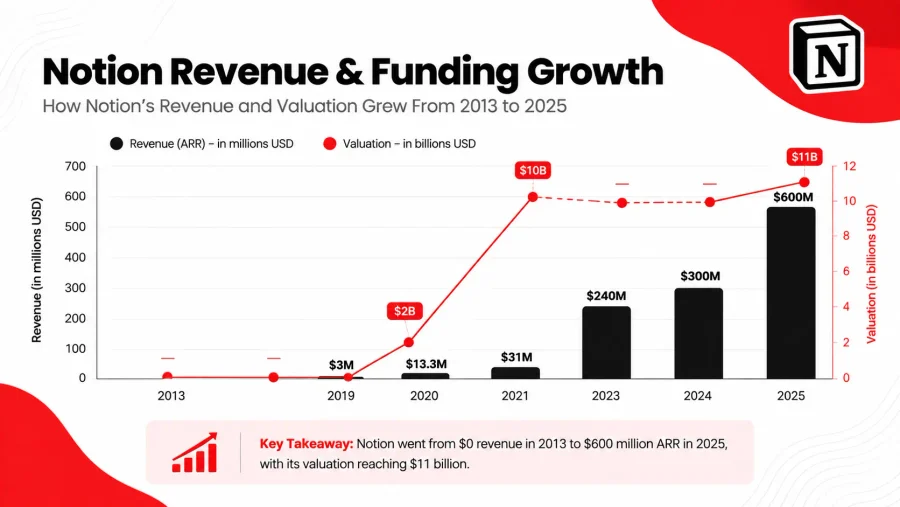
Here’s how Notion’s revenue and valuation have tracked year over year.
| Year | Revenue (ARR) | Valuation |
|---|---|---|
| 2013 | $0 | — |
| 2019 | $3M | — |
| 2020 | $13.3M | $2B |
| 2021 | $31M | $10B |
| 2023 | $240M | — |
| 2024 | $300M | — |
| 2025 | $600M | $11B |
The table shows Notion’s steady, compounding growth rather than one breakout moment. The sharpest jump came in 2021, from $2B to $10B in valuation, holding at $11B through 2026.
Notion growth traces back to a Series A that valued Notion at $800M, shortly after its 2013 founding.
Given the trajectory of the Notion, an IPO comes up often in discussion, though Notion hasn’t confirmed a timeline, so treat it as speculation, not fact.
Source: Crunchbase – Notion • TechCrunch • Forbes
Notion Company Overview: Team, Leadership & Culture
Notion runs lean for its size: around 1,000 core employees against a 100 million+ user base and $11 billion valuation.
Notion is headquartered in San Francisco but operates with a flexible, largely distributed team.
Ivan Zhao is Notion’s CEO and co-founder, leading product vision, while co-founder and COO Akshay Kothari, who previously built and sold Pulse to LinkedIn, has driven scaling since joining in 2018.
Culture leans playful and design-first (employees reportedly get a Lego block for every year they stay), and Notion has grown largely through community, creator programs, education partnerships, and organic word of mouth, rather than heavy paid acquisition.
How Much Does Notion Cost?
Notion runs on four pricing tiers, from $0 to $28 per user per month: Free ($0/month), Plus ($10/month), Business ($20/month), and Enterprise ($28/month).
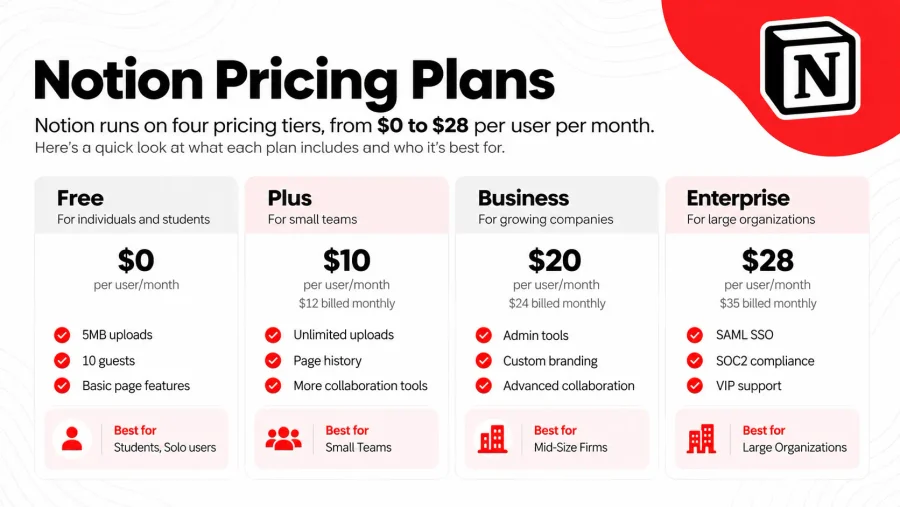
The free plan covers most individual and student needs, with the real value kicking in once teams need unlimited uploads or admin controls.
The AI add-on runs an extra $10 per user per month on top of any paid plan, while education accounts stay free regardless of tier.Z
| Plan | Price/User | Billing | Target | Key Features |
|---|---|---|---|---|
| Free | $0/month | Free | Students, Solo | 5MB uploads, 10 guests |
| Plus | $10/month | $12 billed monthly | Small Teams | Unlimited uploads, page history |
| Business | $20/month | $24 billed monthly | Mid-Size Firms | Admin tools, custom branding |
| Enterprise | $28/month | $35 billed monthly | Large Orgs | SAML SSO, SOC2, VIP support |
Notion’s free plan is free for students and solo users. Business runs $20/user monthly ($24 billed monthly), and the AI add-on costs an extra $10/user/month on any paid plan.
Use the Notion free trial to test paid features before committing.
AI Add-On: +$10/user/month. Education plans remain free.
What this means: AI and enterprise tiers now drive >60% of Notion’s revenue.
Trend takeaway: AI is a big part of why Notion has grown so fast, and comparing it to other AI tools like Perplexity AI shows this trend goes beyond just Notion.
How Many Users Does Notion Have in 2026?
Notion crossed 100 million users in August 2024, a figure CEO Ivan Zhao announced in the company’s “100 Million of You” blog post. That number still holds as the public benchmark heading into 2026, now described as 100 million+ across 85+ countries.
Notion User Growth Over the Years
Notion grew from 1 million registered users in 2019 to more than 100 million in 2024.
Source: Forbes. The 2024 figure represents 100 million+ registered users.
One honest caveat: total users counts every registered account, free and paid. Daily active users run lower, with outside estimates landing somewhere in the 20 to 30 million range based on typical productivity-app usage patterns.
Notion hasn’t published an updated total user count since the 2024 milestone, so the 100 million+ figure, while still the official benchmark, may understate actual 2026 growth.
| Metric | Year / Period | Users / Details |
|---|---|---|
| Registered Users | 2019 | 1 million |
| Registered Users | 2020 | 4 million |
| Registered Users | 2021 | 20 million |
| Registered Users | 2022 | 30 million |
| Registered Users | 2024 | 100 million+ |
| User Growth | 2021–2024 | 5× growth |
| Paying Customers | Current reported figure | 4 million+ |
| Free-to-Paid Conversion | Based on 100M+ users | 4% |
Source: Forbes
Who Are Notion’s Users by Demographic?
Notion has a global user base, with most users coming from outside the United States.
The Notion figures below show its approximate reach across key markets.
Notion Users by Demographic
Approximate user share across key regions and countries.
Note: These figures are approximate and are not intended to represent a single 100% distribution.
These figures highlight Notion’s strong international presence across the U.S., U.K., Canada, India, and other markets.
| Region / Country | Approximate Share (%) |
|---|---|
| Outside United States | 80 |
| United States | 22 |
| United Kingdom | 7 |
| Canada | 5.7 |
| India | 5 |
| Other countries | 60.3 |
This split reflects how Notion grew: organically through word of mouth, templates, and community content rather than enterprise sales in one core market.
The international skew also fits Notion’s flexible, language-agnostic design.
What Do Customer Reviews Say About Notion?
Here’s how customers and employees rate Notion across different platforms.
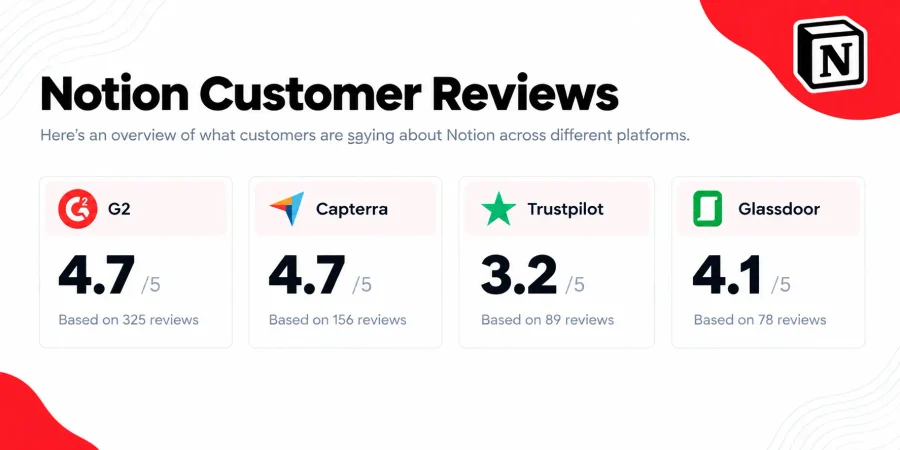
On review platforms, Notion holds a 4.7 on both G2 and Capterra, and 3.2 on Trustpilot. On the employee side, Glassdoor shows Notion Labs at 4.1 out of 5 across 325 reviews, with 81% of employees recommending it and 89% approving of CEO Ivan Zhao.
| Platform | Score | Highlights | Concerns |
|---|---|---|---|
| G2 | 4.7 | AI tools, template gallery, docs + tasks | Can lag with large databases |
| Capterra | 4.7 | All-in-one design | Some onboarding complexity |
| Trustpilot | 3.2 | Free features praised | Billing and cost transparency issues |
| Glassdoor | 4.1 | 89% CEO approval, transparent leadership | Fast pace, hybrid office requirement |
Some reviewers note Notion can lag with large databases, and being cloud-based, it’s only as reliable as your connection, worth a look at how often that’s actually a problem in our Internet Outage Statistics breakdown.
Source: G2 • Capterra • Trustpilot
How Does Notion Compare to Its Competitors?
Notion isn’t the fastest or the most automated tool on the market, but it wins on flexibility.
Here’s how Notion stacks up against the most popular note-taking apps on the market.
| Feature Area | Notion | OneNote | Evernote | Apple Notes | Google Docs | Obsidian | Google Keep | Ulysses |
|---|---|---|---|---|---|---|---|---|
| Custom Docs/Databases | Best-in-class | Basic | Basic | Not supported | Strong (docs only) | Strong (via plugins) | Not supported | Not supported |
| Free Plan | Yes | Yes | Limited | Yes | Yes | Yes | Yes | No |
| Cross-Platform Sync | Yes | Yes | Yes | Apple only | Yes | Manual/paid sync | Yes | Apple only |
| Offline Access | Limited | Full support | Full support | Full support | Partial | Full support | Limited | Full support |
| Community Templates | 1M+ | Limited | Limited | None | Limited | Large plugin ecosystem | None | None |
| Best For | All-in-one workspace | Quick note capture | Web clipping/archiving | Simple Apple-native notes | Collaborative docs | Local, linked notes | Quick lists/reminders | Long-form writing |
Takeaway: Notion’s edge is breadth, it’s a database, wiki, and doc editor in one, which is why it draws teams over solo note-takers.
Who Are Notion’s Strategic Investors?
Notion investors include top-tier venture names:
- Sequoia Capital
- Index Ventures
- First Round Capital
- IVP
- Coatue Management
This backing has pushed Notion Labs Inc deeper into enterprise and education markets, fueling the Notion valuation growth from startup to $11 billion leader. With that kind of investor lineup, it’s no surprise people also search for who owns Notion Labs.
What Is Notion’s Founding Story and Mission?
Founded in 2013 by Ivan Zhao and Simon Last, Notion nearly ran out of money before rebuilding from scratch in 2015 while in Japan, one of the defining moments in the Notion founding story. That reset shaped the product into what it is today.
Akshay Kothari joined soon after as co-founder and COO, bringing product experience from LinkedIn that helped the company scale past its early struggles. Between Zhao, Last, and Kothari, Notion’s founding team combined product vision with the operational chops to actually grow it.
With a relentless focus on user experience and modular design, Ivan Zhao took Notion from underdog to market leader in productivity software, a mission that still shows up today in the company’s push to build tools flexible enough to match how people actually think and work, rather than forcing them into rigid formats.
A couple of things people often search for alongside the founding story: Ivan Zhao’s net worth isn’t officially disclosed, though unofficial estimates put it somewhere around $1.5–1.7 billion, worth treating as a rough figure rather than confirmed fact.
Ivan Zhao’s education is easier to pin down: he studied cognitive science at the University of British Columbia.
Source: Notion’s official press timeline and TechCrunch profile
Notion’s Latest Updates: A 2026 Timeline
In 2026, Notion has rolled out a wave of updates to its app.
- January 20, 2026: Notion released 3.2 with mobile AI note transcription, a new People Directory database, and AI usage analytics for enterprise admins.
- March 26, 2026: Notion 3.4 shipped a new dashboard view for databases, a redesigned sidebar, and presentation mode that turns any doc into a slideshow.
- April 2026: Notion rolled out 10 new features in one update, most notably Workers for Agents, letting AI execute code and compute real results from database queries, plus a Views API with 8 endpoints for developers.
- August 14, 2026: Notion redesigned its AI model picker, adding scorecards to compare speed, intelligence, and cost across models.
- August 19, 2026: Notion launched a dedicated Developer section for managing Workers, API connections, and access tokens.
- September 2026: Notion introduced Skills, a shared library of reusable AI instructions teams can build once and export to tools like Claude Code, Cursor, or Gemini, alongside Custom Agents upgrades and a new Notion Agents iOS app.
Notion’s 2026 focus has shifted from text generation to AI agents that execute real work, part of the same wave driving conversational AI adoption, more on that shift in our Chatbot Statistics breakdown.
Why People Use Notion in 2026?
Notion serves a wide range of purposes, which is a big part of why it’s stuck around with so many users.
Here’s what people actually use Notion for.
- Studying: With a free plan available to students, Notion has become a go-to for organizing coursework, notes, and study schedules, no surprise it’s a favorite in that group.
- Organizing life: Beyond work, plenty of people use Notion daily just to think more clearly and keep their day-to-day tasks in order.
- Storing information: From passwords to important documents to car details, many treat Notion as a safe, centralized place to keep information they don’t want to lose track of.
- Work: Some companies mandate Notion as their internal tool of choice, while others adopt it simply because employees prefer it over alternatives.
- Building a resume/CV: Notion’s flexibility makes it easy to design a clean, minimal resume, some even build their entire CV directly on a Notion page.
- Building websites: A surprising number of people turn Notion pages into functional websites, no separate web builder required.
- Project management: Teams use Notion to map out upcoming projects, assign tasks, and give everyone visibility into what’s happening and who owns what.
- Note-taking: This is Notion’s core use case and the reason behind its name, simple, flexible notes that adapt to however you think.
- Stats and analytics: Notion’s database features let people build custom tables to track personal or team analytics without needing a separate tool.
- Everything, eventually: Once people get comfortable with Notion, it tends to expand into every part of their workflow, which is why so many describe it as less of an app and more of a habit.
Conclusion: What Notion’s Numbers Say?
Read together, these Notion statistics describe a company that scaled users and revenue far faster than it scaled its team.
100M+ users, Notion ARR $865M, 82% growth, and an $11B valuation on roughly 1,000 core staff add up to one of the most capital-light stories in modern software.
AI turned into the growth engine, enterprises turned into real customers, and the community kept marketing costs low.
For the AI-encyclopedia angle, see how Grokipedia is tracking on that same front.
The open questions now are whether Notion files for an IPO, how it holds up against Microsoft and Google, and whether AI agents can keep growth this quick.
For the latest official figures, Notion’s blog and pricing page remain the best primary sources.
FAQs About Notion Statistics
How Many Users Does Notion Have In 2026?
Notion has 100 million+ registered users across 85+ countries. Daily active users are estimated lower, around 20 to 30 million.
How Many Fortune 500 Companies Use Notion?
More than half of Fortune 500 companies use Notion, with some 2026 trackers citing closer to 75%.
Is Offline Access Fully Supported In Notion In 2026?
No. Notion supports offline pages and editing, but some advanced blocks, sharing, permissions, and database features require internet access.
Can Notion Integrate With Other Enterprise Software?
Yes. Notion connects with enterprise tools through integrations, APIs, SSO, SCIM, and services including Slack, Jira, Microsoft Teams, and Google Workspace.
