
Spotify closed the first half of 2026 as the biggest audio streaming service on the planet, with 777 million monthly listeners and a paid base that just cracked a number no rival has touched.
If you want the current picture of how many people use Spotify, how much money it makes, and who they are all listening to, this page pulls the latest verified figures into one place. Every stat here is sourced and dated so you can check the receipts.
Quick Answer: Spotify Stats at a Glance
Here are the headline numbers as of Spotify’s most recent reporting, with stats for spotify offering a quick overview of its performance.
| Metric | Latest figure | Source and date |
|---|---|---|
| Monthly active users | 777 million | Spotify Q2 2026 earnings, Aug 4, 2026 |
| Premium subscribers | 300 million | Spotify Q2 2026 earnings, Aug 4, 2026 |
| Ad-supported users | 494 million | Spotify Q2 2026 earnings, Aug 4, 2026 |
| Full-year 2025 revenue | €17.19 billion | Spotify FY2025 results, Feb 10, 2026 |
| Markets served | 184 | Spotify Q1 2026 reporting, Apr 28, 2026 |
| Tracks in catalog | 100 million-plus | Spotify company data, 2026 |
| Podcast titles | 7 million-plus | Spotify company data, 2026 |
| Music industry payouts (2025) | $11 billion | Spotify Loud & Clear, Mar 11, 2026 |
A quick note on the playlist figure you may have seen quoted at nearly 10 billion.
Spotify has not published a fresh official playlist count recently, and third-party trackers land in the billions without agreeing on a precise number. Treat any exact playlist total as an estimate, not a confirmed company stat.
How Many People Use Spotify?
Spotify reported 777 million monthly active users (MAUs) at the end of Q2 2026, covering April through June.
That total grew 12% year over year and added 16 million net new Spotify users in a single quarter, according to stats for Spotify earnings release from August 4, 2026.
MAUs count everyone who opened the app during the month, whether they pay or listen for free.
It is the widest measure of Spotify’s reach, and it keeps climbing even as the company works through what it called “product optimizations” that trimmed the quarter’s total slightly below its own 778 million forecast.
Spotify Monthly Active Users
Quarterly, Q1 2015 – Q2 2026 (millions)
| Year/Quarter | Spotify Monthly Active Users |
|---|---|
| Q2 2026 | 777 million |
| Q1 2026 | 761 million |
| Q4 2025 | 751 million |
| Q3 2025 | 713 million |
| Q2 2025 | 696 million |
| Q1 2025 | 678 million |
| Q4 2024 | 675 million |
| Q3 2024 | 640 million |
| Q2 2024 | 626 million |
| Q1 2024 | 615 million |
| Q4 2023 | 602 million |
| Q3 2023 | 574 million |
| Q2 2023 | 551 million |
| Q1 2023 | 515 million |
| Q4 2022 | 489 million |
| Q3 2022 | 456 million |
| Q2 2022 | 433 million |
| Q1 2022 | 422 million |
| Q4 2021 | 406 million |
| Q3 2021 | 381 million |
| Q2 2021 | 365 million |
| Q1 2021 | 356 million |
| Q4 2020 | 345 million |
| Q3 2020 | 320 million |
| Q2 2020 | 299 million |
| Q1 2020 | 286 million |
| Q4 2019 | 271 million |
| Q3 2019 | 248 million |
| Q2 2019 | 232 million |
| Q1 2019 | 217 million |
| Q4 2018 | 207 million |
| Q3 2018 | 191 million |
| Q2 2018 | 180 million |
| Q1 2018 | 157 million |
| Q4 2017 | 160 million |
| Q3 2017 | 149 million |
| Q2 2017 | 138 million |
| Q1 2017 | 132 million |
| Q4 2016 | 123 million |
| Q3 2016 | 113 million |
| Q2 2016 | 104 million |
| Q1 2016 | 96 million |
| Q4 2015 | 91 million |
| Q3 2015 | 82 million |
| Q2 2015 | 77 million |
| Q1 2015 | 68 million |
Data Insight & Forecast
Spotify’s MAUs have grown from 68 million in 2015 to 777 million in 2026. Growth has slowed over time, but Spotify is still adding users at a strong rate of about 11–12% each year. Based on this recent trend, Spotify could reach 900 million users by 2027 and around 1 billion users by 2028–2029, if growth continues at a similar rate.
Distribution of Spotify Monthly Active Users by Region for Q2 2026
As of Q2 2026, the distribution of Spotify users by MAU(Monthly active users) by region is presented below.
| Region | Share of Spotify MAUs |
|---|---|
| Europe | 37% |
| Rest of World | 25% |
| North America | 21% |
| Latin America | 16% |
For comparison, you can also see how many users does Instagram have and how its audience compares with other major platforms.
Data Insight & Forecast
Europe is Spotify’s largest region, making up 37% of total MAUs, while North America accounts for 21%. Together, these two regions represent 58% of Spotify’s users. This shows that Spotify has a strong user base in its established markets, while the remaining 42% comes from Latin America and the Rest of the World. Future user growth is likely to depend increasingly on expanding in these less-developed markets.
Stats for Spotify on Revenue Through Premium Subscribers
So, now the real question arises how much revenue does Spotify makes from their users in this case premium users who have purchased the Spotify premium plan.
Spotify Total Revenue and YoY Growth, 2016–2025
Annual revenue (€B) and year-over-year growth (%)
| Year | Total Revenue (€) | Total Revenue ($) | YoY Growth |
|---|---|---|---|
| 2026 (Q1) | €4.500B | $5.23B | — |
| 2025 | €17.186B | $20.208B | 9.70% |
| 2024 | €15.673B | $18.338B | 18.30% |
| 2023 | €13.247B | $15.499B | 13.00% |
| 2022 | €11.727B | $13.720B | 21.30% |
| 2021 | €9.668B | $11.311B | 22.70% |
| 2020 | €7.880B | $9.220B | 16.50% |
| 2019 | €6.764B | $7.914B | 28.60% |
| 2018 | €5.259B | $6.153B | 28.60% |
| 2017 | €4.090B | $4.785B | 38.60% |
| 2016 | €2.952B | $3.453B | — |
Sources: Spotify Form 20-F and Form 6-K filings.
Data Insight & Forecast
Spotify generated €4.50B in Q1 2026, which is about 26% of its total 2025 revenue of €17.19B in just one quarter. Revenue has continued to rise each year, but growth has slowed from 38.6% in 2017 to 9.7% in 2025. If Q1 2026’s pace continues through the year, Spotify could generate around €18B in 2026, with revenue likely to continue growing at a moderate rate in the following years.
Spotify Premium ARPU
Average revenue per user (ARPU) measures how much each paying subscriber brings in.
Premium ARPU landed at €4.70 in Q4 2025, and Spotify reported ARPU up 7% year over year in Q2 2026, helped by price increases (Spotify Q4 2025 shareholder deck, Feb 10, 2026; The Globe and Mail, Aug 2026).
ARPU has been a balancing act. Fast growth in lower-priced regions pulls the average down, while price hikes in mature markets push it back up. The net result lately has tilted positive.
What is Spotify Revenue Through Ad-Supported Plan?
Next, lets see how much Spotify revenue is generated through their free users by showing them ads.
| Year / Quarter | Revenue (€) | Revenue ($) | YoY Growth |
|---|---|---|---|
| 2026 (Q1) | €385M | $447.5M | — |
| 2025 | €1.830B | $2.127B | −1.08% |
| 2024 | €1.850B | $2.151B | 10.05% |
| 2023 | €1.681B | $1.954B | 13.89% |
| 2022 | €1.476B | $1.716B | 22.19% |
| 2021 | €1.208B | $1.404B | 62.15% |
| 2020 | €745M | $866M | 9.88% |
| 2019 | €678M | $788M | 25.09% |
| 2018 | €542M | $630M | 30.29% |
| 2017 | €416M | $484M | 41.02% |
| 2016 | €295M | $343M | 50.51% |
| 2015 | €196M | $228M | — |
Data Insight & Forecast
Spotify’s revenue from this segment grew from €196M in 2015 to €1.83B in 2025, showing strong long-term growth. However, growth has slowed sharply, from 41.0% in 2017 to -1.1% in 2025, meaning revenue was slightly lower than the year before. Q1 2026 generated €385M, which is about 21% of 2025’s full-year revenue. If the segment returns to modest growth, it could reach around €1.9–2.0B in annual revenue over the next few years. The main issue to watch is whether Spotify can reverse the recent decline and return to steady growth.
What is Spotify Revenue Share Paid vs Ad-Supported Users?
The data shows that Premium users generate much more revenue, while free users provide Spotify with a large audience that can be monetized through advertising.
Key data points:
- Premium revenue: Spotify’s revenue increased from €2.95B in 2016 to €17.19B in 2025, an increase of more than 5 times.
- Ad-Supported revenue: Revenue increased from €196M in 2015 to €1.83B in 2025, also showing strong long-term growth.
- Revenue gap: In 2025, the Premium-related revenue shown in the data was about 9 times higher than Ad-Supported revenue (€17.19B vs. €1.83B).
- Premium growth: Premium revenue grew 9.7% in 2025, continuing its upward trend but at a slower rate than in earlier years.
- Ad-Supported growth: Ad-Supported revenue fell by 1.1% in 2025, after several years of growth. This shows that Spotify’s advertising business is currently growing more slowly than its subscription business.
- Q1 2026: Spotify reported €4.50B in total revenue and €385M in Ad-Supported revenue. The Q1 figure is quarterly, so it should not be compared directly with the full-year figures.
What the data suggests: Spotify had 777M MAUs in Q2 2026, while its investor-relations page reports 300M subscribers at that point. That means a large part of Spotify’s audience does not pay for a subscription, although MAUs and subscribers are measured differently and should not be treated as directly equivalent groups.
What is Spotify Market Share in Music Streaming Industry?
With 31.70% market share Spotify is even bigger than apple when it comes to music streaming industry, Spotify is a leader in this niche.
Spotify remains the leading service in this niche, although its audience is smaller than some of the world’s largest social platforms.
Global Music Streaming Market Share
Share of subscribers by music streaming service
| Music Streaming Service | Share Of Subscribers |
|---|---|
| Spotify | 31.70% |
| Tencent Music | 14.40% |
| Apple Music | 12.60% |
| Amazon | 11.10% |
| YouTube Music | 9.70% |
| NetEase | 6.70% |
| Yandex | 3.40% |
| Deezer | 1.30% |
| Other | 9.70% |
Source: Statista
For context, our data on how many Facebook users there are shows the scale of Facebook’s global audience.
Spotify Listening Statistics
One consistent finding across audience research is that North Americans listen the longest and Europeans the least (Business of Apps, June 2026). The specific daily minute estimates below come from secondary panel data and appear to be a few years old, so treat them as ballpark figures to verify:
| Region | Estimated daily listening |
|---|---|
| North America | About 140 minutes |
| Middle East and Africa | About 124 minutes |
| Latin America | About 117 minutes |
| Asia Pacific | About 110 minutes |
| Europe | About 99 minutes |
How Many Songs Are on Spotify?
Spotify’s public, consistent figure is more than 100 million tracks. The company also says roughly 60,000 new tracks are added every day, which works out to something like 22 million new songs a year.
You may run into a much larger figure floating around, closer to 250 million, attributed to company leadership.
That higher number is not part of Spotify’s standard public reporting, so lean on the confirmed 100 million-plus and treat anything larger as unverified.
Interesting fact: At 60,000 new tracks a day, the catalog grows faster than anyone could ever listen. The practical effect is brutal competition for attention: most uploaded tracks never reach 1,000 streams, which is part of why playlist placement and Spotify’s recommendation algorithm carry so much weight for artists.
Spotify AI-Generated Music and Catalogue Growth
The flood of new uploads increasingly includes AI-generated material, and Spotify has responded with new verification and labeling measures for AI content. Alongside its Q2 2026 results, the company announced a deal with Merlin tied to its upcoming fan-made covers and remixing tool, while stressing that human artists should stay central to any AI features (KuCoin, Aug 2026). Expect this to be an active area of policy and product change through 2026.
Who Are the Most Popular Artists on Spotify?
Taylor Swift is the most-streamed artist in Spotify history, with 128,646,877,050 streams worldwide as of September 3, 2026.
The ranking below shows the most-streamed artists on Spotify based on lead artist streams. Streaming totals and rankings can change as artists continue to gain streams.
[Chart]
| Artist | Spotify Streams |
|---|---|
| Taylor Swift | 128.65 billion |
| Drake | 105.10 billion |
| Bad Bunny | 99.37 billion |
| The Weeknd | 85.49 billion |
| Ariana Grande | 67.37 billion |
| Ed Sheeran | 60.60 billion |
| Billie Eilish | 58.86 billion |
| Eminem | 57.99 billion |
| Kanye West | 56.60 billion |
| BTS | 53.81 billion |
| Justin Bieber | 53.24 billion |
| Bruno Mars | 51.61 billion |
| Post Malone | 50.88 billion |
| Rihanna | 48.79 billion |
| Coldplay | 47.56 billion |
| Travis Scott | 44.33 billion |
| Kendrick Lamar | 43.67 billion |
| Dua Lipa | 42.03 billion |
| J Balvin | 40.82 billion |
| Imagine Dragons | 40.58 billion |
Source: Chartmaster
How Much Does Spotify Pay Per Stream?
Spotify pays estimated $0.003 to $0.005 per steam, in case you want to be an artist on Spotify I have brought you the complete estimated earning table below.
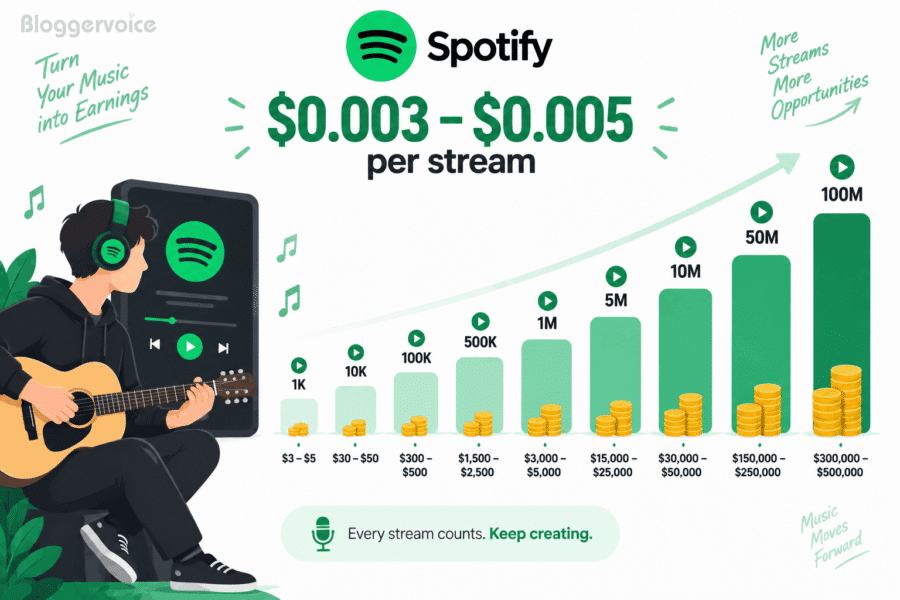
| Streams | Low Estimate ($0.003) | Average ($0.004) | High Estimate ($0.005) |
|---|---|---|---|
| 1,000 | $3 | $4 | $5 |
| 10,000 | $30 | $40 | $50 |
| 100,000 | $300 | $400 | $500 |
| 250,000 | $750 | $1,000 | $1,250 |
| 1,000,000 | $3,000 | $4,000 | $5,000 |
| 10,000,000 | $30,000 | $40,000 | $50,000 |
How Much Does Spotify Pay the Music Industry?
Spotify paid out a record $11 billion to the music industry in 2025, according to its Loud & Clear report published March 11, 2026. That was up more than 10% year over year, more than double the growth rate of other industry income sources.
For comparison, the 2024 payout was $10 billion, and the annual figure was around $1 billion a decade earlier in 2014.
Spotify’s Lifetime Music Industry Payouts
Add it all up, and Spotify says its lifetime payouts to the music industry are approaching $70 billion since the service launched (Loud & Clear, Mar 11, 2026). The company positions itself as the highest-paying retailer in music history and now accounts for roughly 30% of recorded music revenue globally.
Independent Artists’ Share
Independents are not an afterthought in these numbers. Spotify reports that about half of all royalties go to independent artists and labels, who together generated more than $5 billion in 2024. The 2025 report also counted more than 13,800 artists earning at least $100,000 a year from Spotify alone, over 1,500 earning $1 million-plus, and 80 clearing $10 million.
Fair warning: these headline totals describe money paid to rights holders, not take-home pay for artists after labels, distributors, and other cuts.
Spotify Stats Timeline
A compressed history of Spotify stats how it got here:
- 2016: Spotify Wrapped launches in its modern annual form
- 2021: Music industry payouts pass $7 billion for the year
- 2023: Annual revenue reaches €13.247 billion
- 2024: Spotify posts its first full-year net profit (€1.14 billion)
- 2025: Revenue climbs to €17.186 billion; annual payouts hit a record $11 billion
- Q1 2026: MAUs reach 761 million
- Q2 2026: MAUs hit 777 million and Premium subscribers reach 300 million, an industry first
What Do Spotify’s Statistics Tell Us?
- User growth is still real, not just recycled: Spotify keeps adding tens of millions of net new monthly users, and most of that expansion now comes from the Rest of the World and Latin America.
- Premium is the money story: Passing 300 million paying subscribers, while raising ARPU through price increases, is what flipped Spotify from a perennial money-loser into a genuinely profitable business.
- Revenue and margins are moving together: A record 33.4% gross margin alongside 14% revenue growth in Q2 2026 shows the company can grow and keep more of each euro at the same time.
- Profitability has arrived: Two straight years of net profit, with 2025 nearly doubling 2024, put an end to the old “great product, bad business” narrative.
- Spotify is no longer just music: With 7 million podcast titles, 390 million video-podcast viewers, and a growing audiobook catalog, the company is building an all-day audio platform, similar to how platforms such as TikTok have expanded beyond their original use cases. Our TikTok user statistics provide a closer look at that platform’s audience growth.
Frequently Asked Questions
How Many Songs Are On Spotify?
Spotify has more than 100 million tracks, with roughly 60,000 new tracks added each day.
How Many Countries Is Spotify Available In?
Spotify is available in 184 countries and territories, giving users access to its music, podcasts, and other audio content worldwide.
What Is The Most-streamed Song?
“Die With a Smile” by Lady Gaga and Bruno Mars topped 2025 with over 1.7 billion streams. “Blinding Lights” by The Weeknd holds the all-time record at 4 billion-plus.
How Many Podcasts Are On Spotify?
Spotify has around 7 million podcast titles in its catalog. The platform also offers more than 430,000 video podcast shows and approximately 350,000 audiobooks.
How Many People Listen To Podcasts On Spotify In The Us?
An estimated 42.4 million people in the US listen to podcasts on Spotify each month. Spotify’s US podcast audience grew from 19.9 million in 2020 to 42.4 million in 2025.
How Many People Work at Spotify?
Spotify employed 7,287 people worldwide in 2025, down from 7,691 in 2024. That is still far above its 311 employees in 2011. Spotify also cut jobs heavily in 2022 and 2023 during major restructuring
