
Do you know that you can set up a site in less than 30 minutes using platforms like WordPress. Yet growing that blog into a digital asset takes skill, patience and the right blogging tips.
According to WordPress, users publish around 70 million new blogs each month and this number shows how crowded the blogging space has become.
How Crowded Is the Blogging Industry?
Around 70 Million Blog Posts Are Published Every Month
With such massive publishing volume, standing out requires strategy, SEO, and consistency.
As blogging looks easy so many new bloggers jump in with excitement but most of them quit within months because they face failures again and again.
The problem is not the method but the problem is repeating the same blogging mistakes again and again.
If you want blogging tips that actually bring traffic, leads and growth, this guide will show you what are the biggest blogging mistakes and how to fix them step by step.
Strategic Planning Mistakes
Most of the bloggers take their first step wrong. They generally do buy the domain and the hosting and start writing the blog without any startegic planning which is a wrong way to pursue blogging as a career.
Here are the strategic planning blogging mistakes that should be avoided at any cost:
- Starting A Blog Without A Clear Strategy
- Not Defining A Clear Niche
- Ignoring Keyword Research And Search Intent
1. Starting A Blog Without A Clear Strategy
Many beginner blogging tips focus on design and plugins but very few explain how to set up a blog with long-term direction. That gap leads to frustration within months.
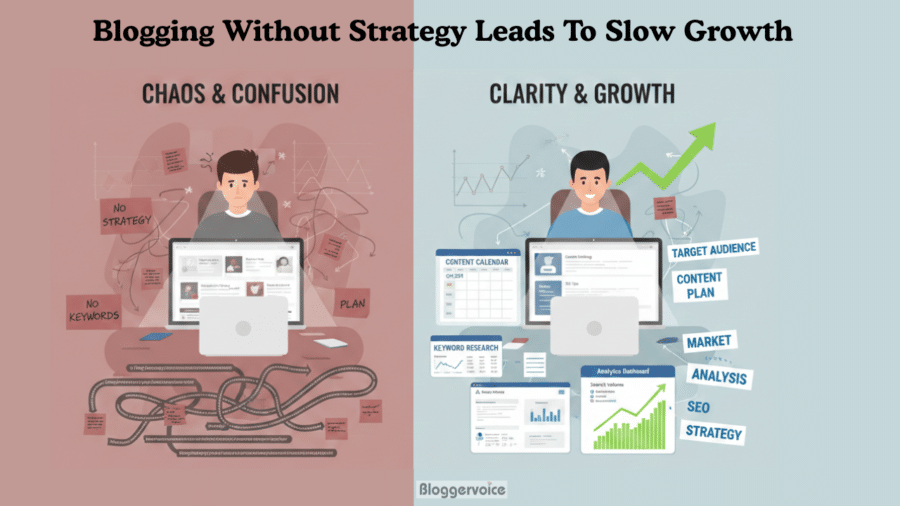
- Not Knowing How to Set Up a Blog Properly
Most beginners search “how to set up a blog,” buy hosting, install a theme and start writing. They just jump into blog writing but skip competitor’s analysis and also they ignore content planning as well.
This approach creates slow growth.
If you truly want to learn how to set up a blog, start with these questions:
- Who exactly are you helping?
- What specific problem will your blog solve?
- What keywords do people search every month?
- How will you stand out in a crowded space?
Ignoring foundational beginner blogging tips creates technical and content gaps. Many new bloggers:
- Do not install analytics from day one
- Fail to set up proper categories
- Use messy URL structures
- Publish thin posts without keyword research
When you correct these early, your blog grows with clarity instead of confusion.
2. Not Defining A Clear Niche
Among all common blogging mistakes, niche confusion ranks high. When blogger chooses the wrong niche the problem begins there only.
- Writing About Everything
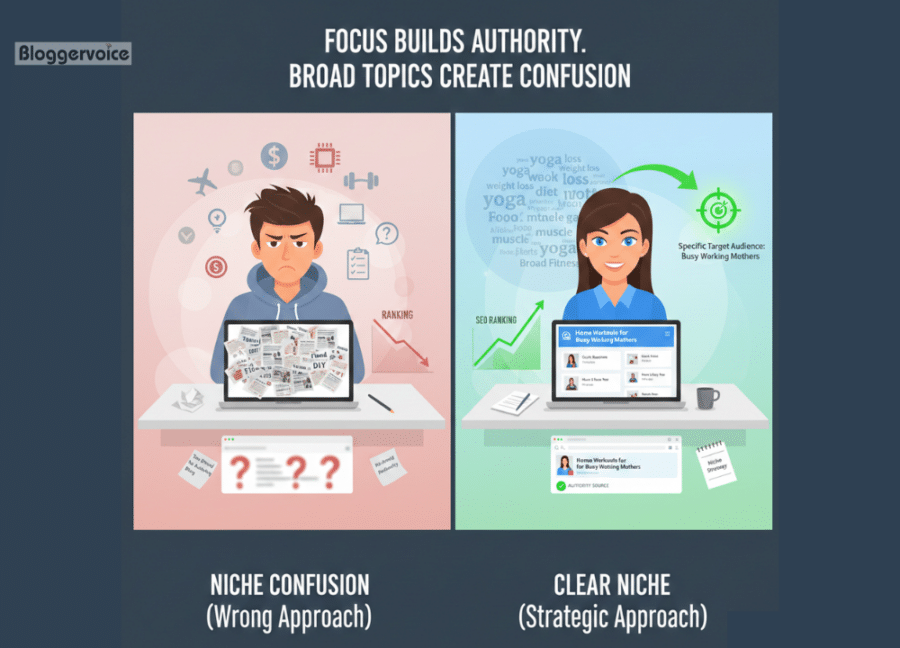
New bloggers often write about travel, finance, productivity and tech on the same website. They actually believe that more topics mean more traffic but search engines do not see it that way.
When your blog covers everything, it stands for nothing and you fail to build topical authority. Search engines also struggle to categorize your website.
This is one of the biggest mistakes new bloggers make. They fear choosing one topic because they worry about missing opportunities but in reality, focus creates growth.
- Choosing a Broad Topic
Broad niches face heavy competition so large media brands dominate those search results and the ranking becomes hard for beginners.
For example “I blog about fitness” sounds fine, yet fitness includes weight loss, muscle gain, yoga, mental health, diet plans and more.
If you choose “home workouts for busy working mothers,” you reduce your competition and increase your relevancy. Focus helps search engines to understand your expertise.
3. Ignoring Keyword Research And Search Intent
Ignoring keyword research is one of the costliest blogging mistakes to avoid in 2026. You may write great content, yet without search intent alignment, traffic stays low.
- Writing Without Understanding Search Intent
Many bloggers write what they want to say, not what users search for and this mismatch kills rankings.
Search intent usually falls into four types:
- Informational
- Navigational
- Transactional
- Commercial
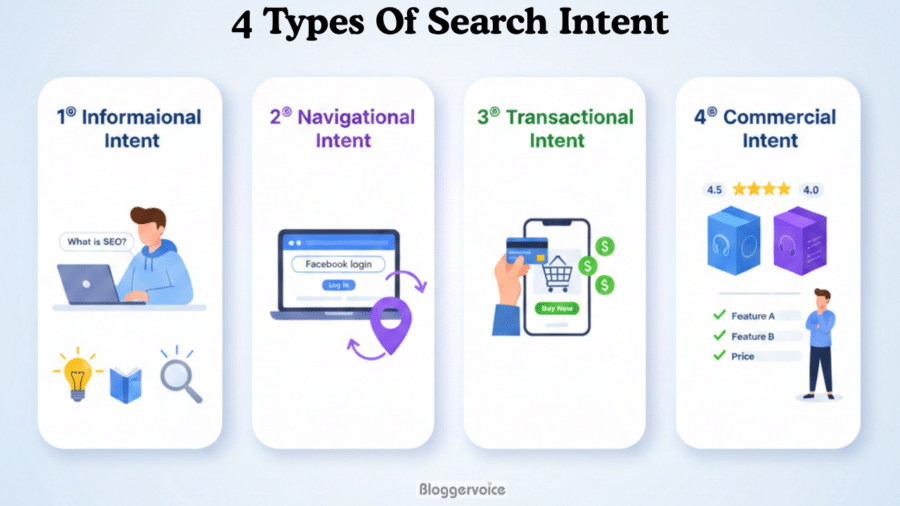
If someone searches “best blogging platforms 2026,” they want comparisons and features or if they search “how to start a blog,” they want a step-by-step guide.
When your content does not match the user intent, it does not rank. Even strong writing fails without alignment.
- Targeting Only High-Competition Keywords
Beginners often target broad keywords like “blogging tips.” Large sites dominate those results and this slows growth.
You publish consistently but see little traction.
Instead of using geeric keywords you can target long-tail phrases or LSI Keywords such as:
Long-tail keywords have lower competition and clearer intent.
Content Creation Mistakes
After strategic planning, the most common blogging mistake bloggers often do are content creation.
4. Weak Headlines
Weak headlines remain one of the most ignored blogging mistakes to avoid in 2026. You may improve your blog writing, design a clean layout and follow SEO rules.
And if your title fails then nobody clicks your post.
Search results have become crowded so every page competes for attention. If your headline sounds generic, readers scroll past it without a second thought.
- Generic Titles Hurt Blog Writing Performance
Many bloggers use titles like:
- Blogging Tips
- How to Blog
- Social Media Guide
These titles say nothing specific and they lack direction. These type of blogs promise bot have no clear outcome.
Generic blog writing leads to low click through rates (CTR). When users ignore your result in search, platforms like Google push it lower over the period of time.
Strong blog writing examples show a different pattern. They include:
- A clear result
- A timeframe
- A number
- A specific audience
Now if you compare these two titles then you will realise the difference:
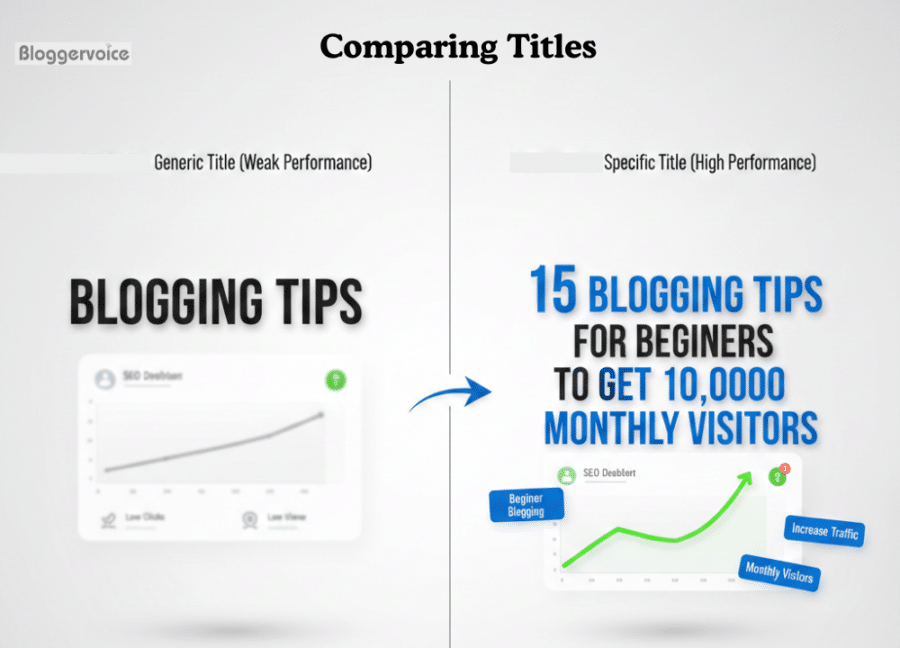
The second title sets an expectation and speaks directly to a reader.
No Clear Benefit Means No Click
Readers scan faster and if your headline does not answer “What is in it for me?” they move on.
When writing a blog always focus on clarity over creativity. Clever wordplay sounds fun but clarity wins clicks.
Instead of writing “wordpress ping list,” write “Free 100+ WordPress Ping List For Fast Indexing Of New Post”
A strong headline multiplies the impact of your content without adding extra work.
- Poor Content Structure and Formatting
Poor formatting stands out as another major blogging mistake to avoid in 2026. Even strong ideas fail when presented badly.
Learning how to write a blog post includes structure, not just ideas.
- Large Blocks of Text Reduce Readability
When readers see long paragraphs with no breaks, they leave as attention spans got short.
According to research published by Nielsen Norman Group, users scan content rather than read word by word.
Large blocks of text create friction which increases bounce rates.
If you want to improve how to write a blog post, follow these formatting principles:
- Use short paragraphs
- Add subheadings
- Include bullet points
- Highlight important phrases in bold
- No Logical Flow Confuses Readers
Another issue in writing a blog is poor organization in which ideas jump randomly from one point to another.
A strong blog content template solves this problem and without structure, readers feel lost and when readers feel lost, they exit.
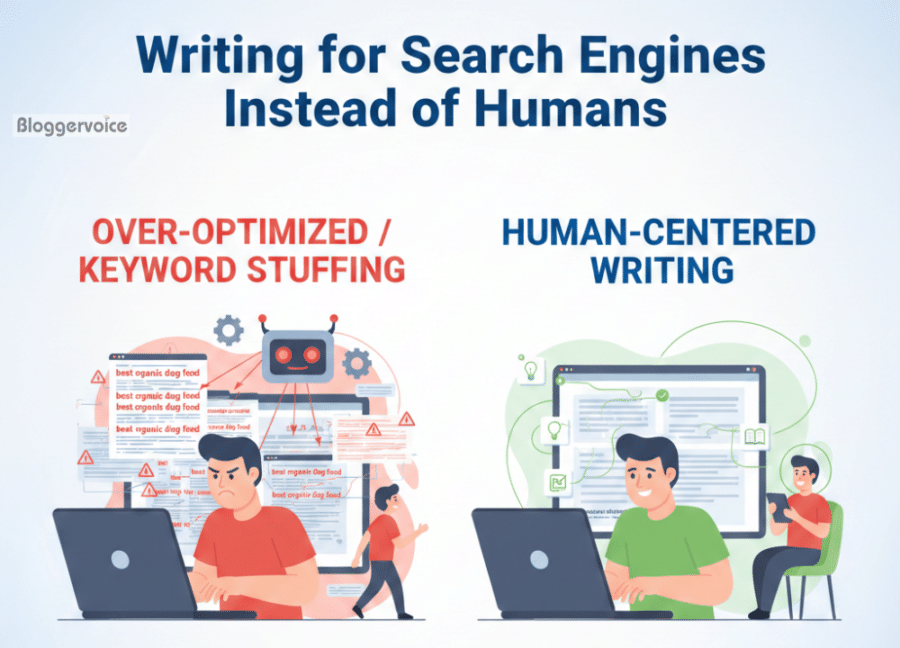
5. Writing For Search Engines Instead Of Humans
Many bloggers misunderstand SEO and they focus only on algorithms and forget real readers.
- Keyword Stuffing Damages Experience
Old SEO advice encouraged repeating keywords again and again and now approach no longer works.
Search engines now evaluate helpfulness and clarity but overusing phrases makes content awkward.
Keyword stuffing leads to poor readability and readers notice it instantly so they leave the blog post.
- Robotic Tone Reduces Engagement
When writers focus too much on ranking, they forget natural flow but the content sounds stiff and it feels forced.
Good blogging tips remind you that humans read your content before search engines rank it.
6. Publishing Low-Value Content
Readers expect in depth research in blogs and search engines reward originality.
- Copying Other Bloggers Destroys Trust
Some beginners rewrite top-ranking posts and change a few words that creates no unique voice.
Copying content also risks plagiarism detection and search engines identify duplicate patterns quickly.
- Low originality limits growth.
Another mistake is giving vague advice like:
- Be consistent
- Write quality content
- Promote your blog
These statements lack depth and do not guide action. Blogging help should include:
- Clear steps and guides.
- Real life examples.
Ignoring SEO Basics: A Costly Blogging Mistake To Avoid
Blogging mistakes to avoid often hide in plain sight and ignoring SEO basics sits near the top of that list. Many bloggers learn how to write a blog with passion and creativity, yet they forget the technical side that helps content rank.
You can publish great articles every week but If your SEO foundation stays weak, traffic stays low.
Search engines like Google evaluate structure, speed and clarity before rewarding visibility.
When you skip simple on-page steps, you reduce your chances of ranking.
7. No Meta Description Or Internal Linking
A missing meta description signals carelessness. While meta descriptions do not directly decide ranking but they influence click-through rates.
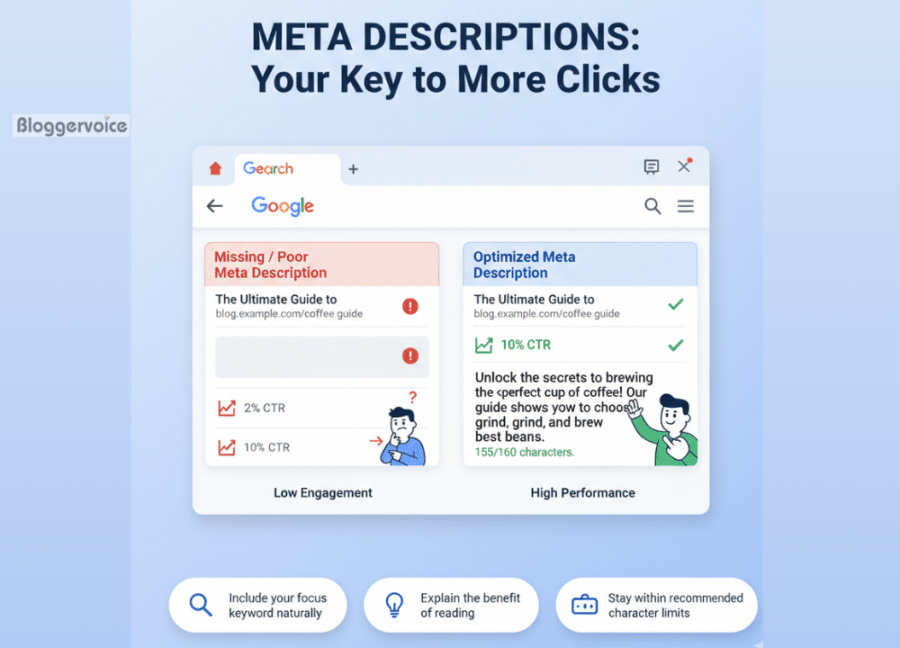
If you want to master how to write a blog that performs well, craft meta descriptions that:
- Include your focus keyword naturally
- Explain the benefit of reading
- Stay within recommended character limits
8. Lack Of Internal Linking
Internal linking also forms a strong SEO base, when you connect related posts, you help search engines understand your site structure and you also keep readers on your website longer.
Without internal links, your content feels isolated. This weak SEO foundation slows growth.
9. Slow Website Speed Hurts Rankings And Readers
Page speed affects rankings and visitor satisfaction. According to Google, page experience and Core Web Vitals are essential parts of ranking systems.
Common causes of slow speed include:
- Heavy images
- Too many plugins
- Cheap hosting
- Poor caching setup
Visitors leave quickly when a page loads slowly this increases bounce rate and lowers engagement.
10. Not Promoting Your Blog
Many bloggers follow a “publish and pray” strategy. In this strategy bloggers hit publish and hope traffic appears but this approach rarely works. Content needs visibility so avoid these blogging mistakes.
- The “Publish and Pray” Strategy Fails
When you skip promotion, your blog relies only on search traffic.
And you know that ranking takes time and during that waiting period, your content sits unnoticed.
If you want readers to check out our blog, you must show up where they spend time.
- Ignoring Social Media and Email Limits Growth
Social media platforms help you reach new audiences and email marketing builds direct communication.
If you ignore both, you miss growth channels.
Platforms like Instagram and LinkedIn allow you to repurpose content into short posts, carousels, and discussions.
Global email users continue to grow each year and building an email list gives you control over distribution.
11. No Clear Call-To-Action: A Silent Growth Killer
You may share useful blogging tips and tricks, yet if you fail to guide readers then engagement drops.
- Not Guiding Readers Leads to No Conversions
Many posts end without direction so readers will finish reading and leave.
12. Ignoring Analytics And Continuous Improvement
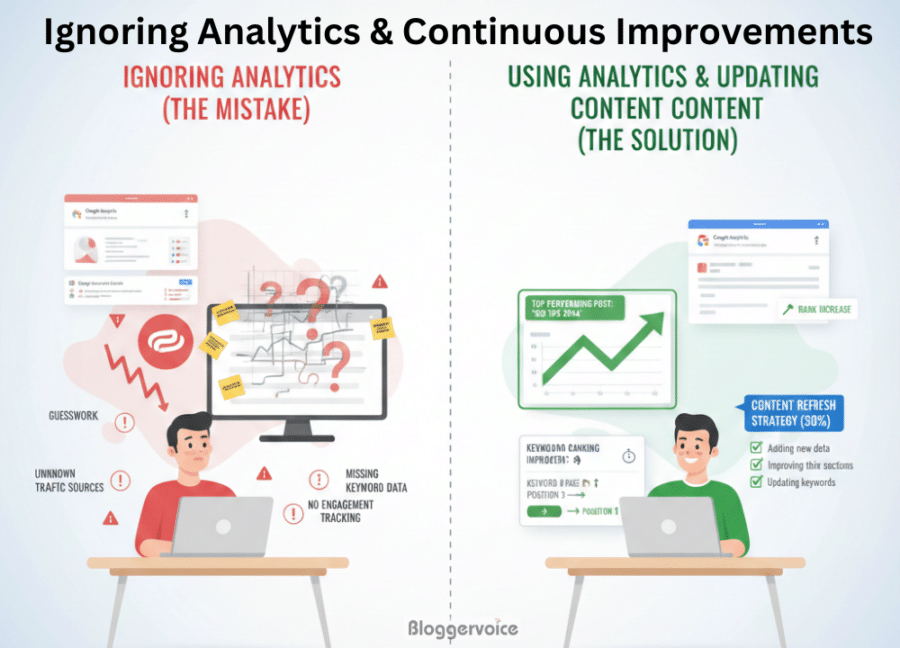
Many bloggers create content but never review performance, this ranks high among blogging mistakes to avoid.
- Not Tracking What Works Creates Blind Spots
Without any data, you will play only on the guesswork.
Tools like Google Analytics and Google Search Console show:
- Which pages attract traffic
- Which keywords bring visitors
- How long users stay
When you skip analytics, you miss patterns.
- Not Updating Old Posts Misses Ranking Opportunities
Older posts often rank on SERP page on two or three position and small updates can move them higher.
30% of content should be refresh to gain the content boost and these changes included:
- Adding new data
- Improving structure
- Expanding thin sections
- Updating keywords
Search engines reward freshness when updates improve quality.
Conclusion
Blogging success in 2026 depends on strategy, clarity and continuous improvement. Most blogging mistakes to avoid happen when beginners rush the process without defining a niche, understanding search intent, or building a strong SEO foundation.
Writing without structure, using weak headlines, ignoring keyword research and skipping promotion can limit growth even if your content is good.
A successful blog starts with a clear audience and a focused topic. It aligns content with what people actually search for.
It prioritizes readability, strong formatting, and helpful depth over surface-level advice. Promotion, analytics and regular updates further strengthen results.
Avoiding common blogging mistakes is not about doing everything perfectly, it is about making intentional decisions from the start.
When you combine strategy with consistency, your blog grows with direction instead of confusion.
