
How much does it cost to start a blog in 2026? You can launch one for about $0, run a solid self-hosted blog for $50 to $100 in your first year, or spend $1,000+ if you pay writers and buy tools. The real answer depends on one choice: how much of the work you do yourself.
This guide breaks down blog pricing piece by piece, from domains and hosting to content, so you know exactly where your money goes before you spend a dollar.
What Is the Cost to Start a Blog?
A basic self-hosted blog costs about $50 to 100 in the first year, covering a domain, hosting and a free platform like WordPress.
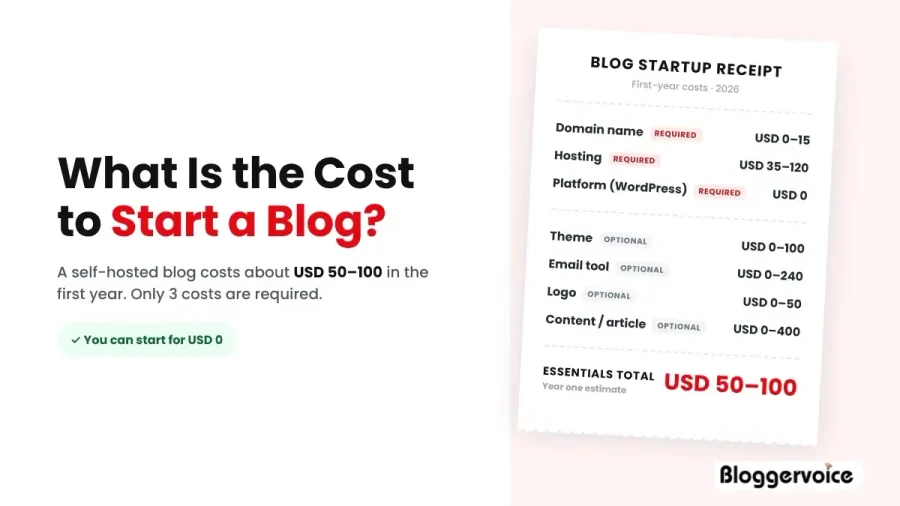
Use this quick snapshot to size up your own spend. Add the rows that apply to you.
| Item | Typical First-Year Cost | Needed? |
|---|---|---|
| Domain name | $0–$15 (often free year one) | Yes |
| Hosting | $35–$120 | Yes (self-hosted) |
| Platform / CMS | $0 (WordPress) to $200/yr | Yes |
| Theme/design | $0–$100 (one-time) | Optional |
| Email tool | $0–$240 | Optional |
| Content (per article) | $0–$400 | Depends |
| Logo/branding | $0–$50 | Optional |
Only 3 of these 7 costs are required. Everything else is optional in your first year.
The math is simple. Take your platform cost, add hosting and a domain, then add whatever you plan to spend on writing. That total is your real cost of starting a blog in your first year.
What You’re Actually Paying For?
Blog prices break into four buckets. Knowing which bucket a cost falls into helps you cut the fat.
- Setup covers the one-time bits, a domain, a theme, maybe a logo. You pay these once (or once a year) and forget them.
- Infrastructure is the plumbing that keeps your site online, mainly hosting and any security or backup tools. This is your steady monthly or yearly bill.
- Content is the writing, editing, and images. For most blogs, this becomes the biggest line item over time, whether you pay in cash or your own hours.
- Growth covers the tools you add later to get traffic and make money, such as SEO software, email marketing, and analytics. You do not need these on day one. Our SEO guide explains which of these matter first.
How Much Does a Blog Cost?
Blog costs stack in four rough tiers: $0, $100, $500 and $1,000+. Pick the one that matches your goal, not your ego.
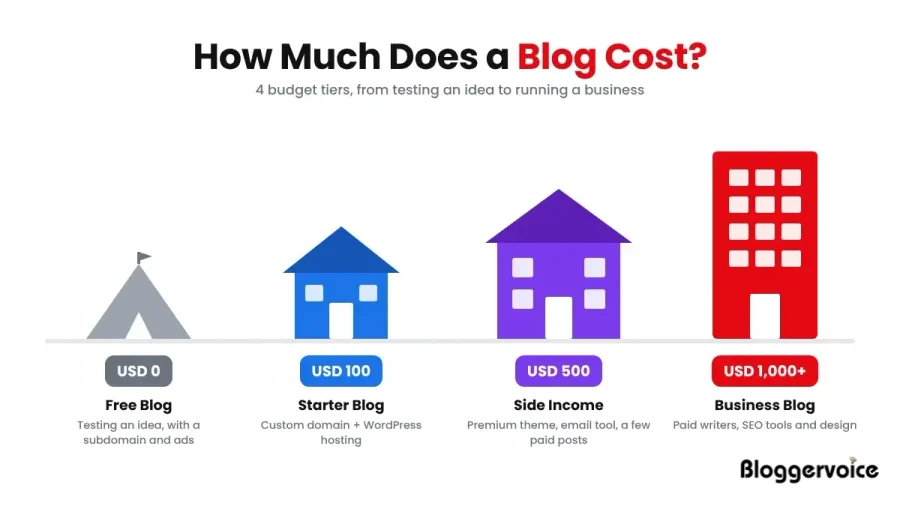
- $0 tier: A free blog on Wix, Blogger, Medium, or WordPress.com. You get a subdomain like yourname.wixsite.com, and the platform shows its own ads. Fine for testing, weak for a brand.
- $100 tier: The classic starter setup: a custom domain plus budget WordPress hosting. This is what most people mean when they ask how much it costs to start a WordPress blog. You own everything and look professional.
- $500 tier: The $100 base plus a premium theme, an email tool, and a handful of paid articles or better hosting. Good for someone treating blogging as a side income.
- $1,000+ tier: A content-first blog. Most of this money buys articles from writers, along with SEO tools and design help. This is a small business, not a hobby.
What Are the 3 Costs You Actually Need?
The only 3 costs you actually need are a domain, hosting and a platform. Strip away the noise and nothing else is non-negotiable.
- Domain. Your web address, such as yoursite.com. A “.com” renews for around $15 to $20 per year, and many hosts throw in the first year free.
- Hosting. The server that stores your site. Budget WordPress hosting starts near $3 a month on an intro deal. Watch the renewal, since it often jumps to $8 to $18 a month.
- Platform or CMS. The software you write in. WordPress.org is free to use. Builders like Wix or Squarespace bundle hosting and charge a monthly fee instead.
That is it. Domain plus hosting plus a free platform gets a real blog online for roughly $50 to $100 in year one.
How Much Does It Cost to Start a WordPress Blog?
A self-hosted WordPress.org blog costs about $50 to 100 in the first year, while WordPress.com plans range from free to $45 a month.
WordPress comes in two versions, and they’re priced very differently:
| Option | Software | What You Pay | First-Year Cost |
|---|---|---|---|
| WordPress.org (self-hosted) | Free | Hosting and domain | About $50–100 |
| WordPress.com Free | Free | Nothing | $0 (with a subdomain and ads) |
| WordPress.com Personal | Included | $4/month, billed yearly | About $48 |
| WordPress.com Premium | Included | $8/month, billed yearly | About $96 |
| WordPress.com Business | Included | $25/month, billed yearly | About $300 |
Self-hosted WordPress.org gives you the most control for the lowest price. WordPress.com is simpler, but you need the Business plan to install most plugins.
Prices from WordPress.com as of late 2026. Check the official pricing page before you buy, since plans change. Ready to set it up? Follow our step-by-step guide on how to start a blog.
How Much Does Blogger Cost?
Blogger is completely free to use. The only optional cost is a custom domain, at about $10 to 20 a year.
Blogger is Google’s free blogging platform. Hosting, security and your yourname.blogspot.com address all cost nothing. If you want a professional address like yourname.com, you can buy a domain and connect it to Blogger for free.
The trade-off is control. Blogger has limited themes and no plugins, and you don’t own the platform your blog runs on. It’s a good choice for hobby blogs and testing ideas, but most bloggers who want to earn money move to WordPress later.
Once you switch, set up a short WordPress ping list so your new posts get discovered faster.
What Are All the Possible Blog Expenses?
Beyond the 3 essentials, possible blog expenses include themes, page builders, email marketing, SEO tools, stock images, branding and content.
Here’s the full list, so nothing surprises you at checkout.
| Expense | Cost | Required? | When | Free Alternative |
|---|---|---|---|---|
| Domain | $0–$15/yr | Yes | Day one | Free subdomain |
| Hosting | $35–$120/yr | Yes (self-host) | Day one | Free platform |
| SSL certificate | $0 | Yes | Day one | Included free |
| Theme | $0–$100 | No | Setup | Free themes |
| Page builder | $0–$99/yr | No | Setup | Native editor |
| Email marketing | $0–$240/yr | No | Month 2+ | Free tiers |
| SEO tool | $0–$1,400/yr | No | Month 3+ | Free tools |
| Stock images | $0–$200/yr | No | Ongoing | Unsplash, Pexels |
| Logo / branding | $0–$50 | No | Setup | Canva free |
| Content | $0–$400/article | Depends | Ongoing | Write it yourself |
9 of these 10 expenses have a free alternative. Most beginners overspend on tools they could skip for a year.
The right blogging resources can help cover writing, SEO, design, research, and other tasks without adding unnecessary costs.
How Much Does Content Cost?
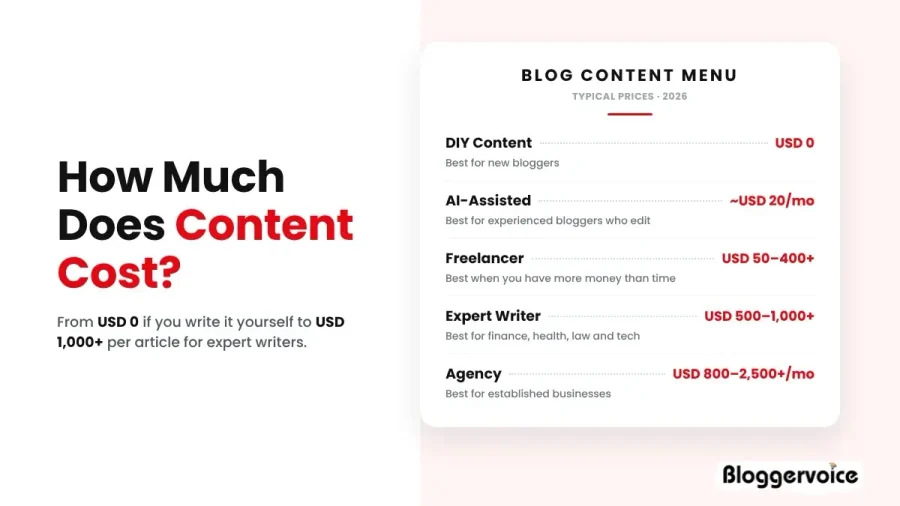
Blog content costs anywhere from $0 if you write it yourself to $1,000+ per article for expert writers. Here’s what each route costs in 2026.
1. DIY Content: Best for New Bloggers
Cost: $0
You research, write, edit, and publish the article yourself. A well-researched 1,500-word post can take several hours.
Use this method if you:
- Have a small budget
- Know your topic well
- Have enough time to write
- Want to learn blogging before outsourcing
For most new bloggers, DIY writing is the best starting point. You can learn your audience and content style before paying writers.
2. AI-Assisted Content: Best for Experienced Bloggers
Cost: Around $20/month for a paid AI tool
AI can help with research, outlines, drafts, editing and content ideas, and our ChatGPT statistics show how quickly bloggers are adopting these tools.
You still need to fact-check the content and add your own knowledge, examples, and experience.
Use this method if you:
- Know the subject well
- Can edit AI-generated drafts
- Want to reduce writing time
- Can fact-check claims
Don’t use AI to publish large amounts of generic content without human review.
3. Freelancer Content: Best When You Have More Money Than Time
Cost: Around $50 to $400+ for a 1,000-word article
Freelance rates vary based on experience, research requirements, subject, and editing needs.
Use this method if you:
- Have a content budget
- Don’t have enough time to write
- Can create clear briefs
- Can review the finished articles
If you’re new to blogging, write some articles yourself before hiring freelancers. It will help you judge the quality of paid work.
4. Expert Writers: Best for Specialist Topics
Cost: Often $500 to $1,000+ per article
Expert writers make more sense for topics such as finance, health, law, and technology where specialist knowledge matters.
Use this method if you:
- Publish specialist content
- Need expert-level knowledge
- Cover topics where accuracy matters
- Run a professional publication or business blog
You don’t need an expert writer for every article. Use them for the topics where specialist knowledge adds real value.
5. Agency Content: Best for Established Businesses
Cost: Often $800 to $2,500+ per month
Agencies can handle research, content planning, writing, editing, and publishing.
Use this method if you:
- Need several articles each month
- Have a larger content budget
- Don’t want to manage individual writers
- Run an established business or publication
For a new solo blog, an agency is usually unnecessary.
Which Content Method Should You Choose?
| Your situation | Best method |
|---|---|
| Very small budget | DIY |
| Good subject knowledge but limited time | AI-assisted + editing |
| Budget available but little writing time | Freelancer |
| Specialist or sensitive topic | Expert writer |
| Established business publishing at scale | Agency |
You can combine methods. Write important articles yourself, use AI for research and editing, and hire freelancers for supporting content. As your blog earns more, you can increase your content budget.
What Do 10, 50 or 100 Articles Cost?
100 articles cost anywhere from $0 if you write them yourself to $80,000 with expert writers. These figures assume a standard 1,000-word post.
| Route | 10 Articles | 50 Articles | 100 Articles |
|---|---|---|---|
| DIY | $0 (your time) | $0 | $0 |
| AI-assisted | ~$20/mo tool | ~$40/mo | ~$60/mo |
| Beginner freelancer ($75) | $750 | $3,750 | $7,500 |
| Pro freelancer ($250) | $2,500 | $12,500 | $25,000 |
| Expert ($800) | $8,000 | $40,000 | $80,000 |
Content, not hosting, decides your real blog budget. The jump from 10 to 100 articles is where most of the money goes.
What Does a $100 vs $500 Article Actually Get You?
A $100 article gets you clean, readable content from a generalist, while a $500 article gets you original research and specialist expertise.
A $100 article usually means a competent generalist writing to a brief. You get clean, readable content that covers the topic. Research is light, and you may need to add your own examples and edits.
A $500 article buys a specialist. You get original research, expert quotes, a sharper angle, SEO structure and writing that reads like someone who has actually done the thing. This is the content that ranks and earns links, which is why serious blogs pay for it.
How Much Does a Blog Cost by Business Model?
A hobby blog costs $0 to 100 a year, while affiliate, lead generation and media blogs can cost $500 to 10,000+ a year. Your goal sets your budget.
- Hobby. You write for fun. Aim for $0 to 100 a year. A free platform or a cheap self-hosted setup covers it.
- Personal brand. You want a professional home base. Budget $100 to 300 a year for a custom domain, decent hosting and a clean theme.
- Affiliate. You review products for commissions. Content volume matters, so plan $500 to 5,000+ a year, mostly on articles and an SEO tool.
- Lead generation. Your blog feeds a business. Budget $1,000 to 10,000+ a year for content, email tools, possibly a designer and expert SEO consulting.
- Media business. You sell ads and sponsorships at scale. This runs $10,000+ a year, since traffic depends on a steady stream of paid content.
How Much Should You Spend?
Most beginners should start with a $100 budget and spend more only once the blog shows results. Here are three realistic starting budgets, and where each dollar goes.
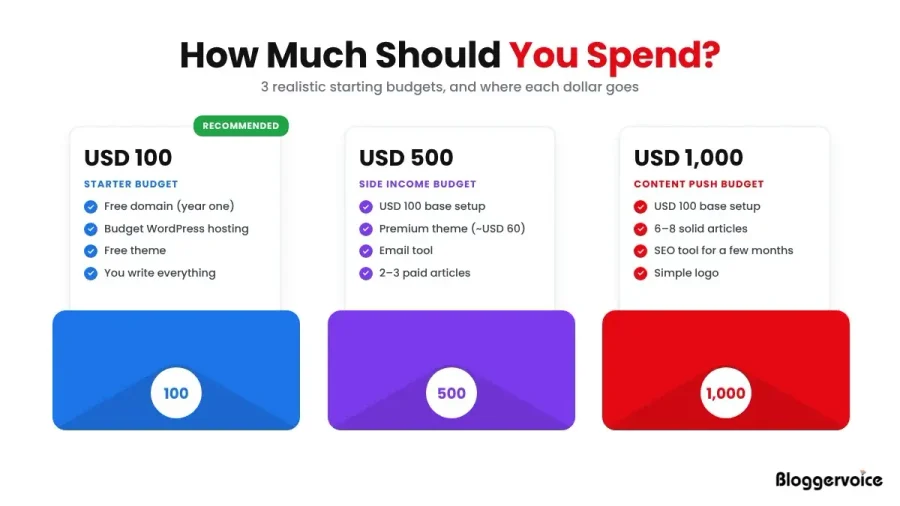
- The $100 budget. Spend it all on the base: a custom domain (free year one), a year of budget WordPress hosting and a free theme. You write everything yourself. This is the smartest starting point for most people.
- The $500 budget. Keep the $100 base, then add a premium theme (~$60), an email tool for your first year, and two or three paid articles to seed the site. Or spend the extra on faster managed hosting.
- The $1,000 budget. Base setup, plus a real content push. Buy six to eight solid articles, add an SEO tool for a few months, and get a simple logo. Now you have a blog with momentum instead of an empty shell.
Where Should Your First $500 Go?
Put your first $500 into a domain and hosting, then spend most of the rest on content. Here’s the order that returns the most.
- Domain and a year of hosting (~$70): Non-negotiable foundation.
- Four to five articles (~$350): Content is what actually brings visitors.
- A free theme and free email tool ($0): Skip paid design early.
- The remaining $80: A logo or a month of an SEO tool.
The pattern is clear. After the basics, put your money into content, not gadgets.
What Don’t You Need to Buy?
You don’t need expensive page builders, premium SEO suites, paid stock photos, a pro logo, lots of plugins or a blogging course in your first year.
Beginners waste cash here. Skip these until you have traffic and income. Buying too many tools too early is one of the common blogging mistakes that can eat into your budget without helping your blog grow.
- Expensive page builders: The native WordPress or builder editor works fine.
- Premium SEO suites: Free tools cover the basics for your first months, including our free robots.txt generator.
- Paid stock photo plans: Unsplash and Pexels are free and good.
- A pro-designed logo: Canva makes a clean one for nothing. You can share your free graphics on image submission sites for extra visibility too.
- Multiple plugins: Each one is another thing to break. Start light.
- A course on how to blog: This article is free.
When Should You Start Spending More?
Spend more once your blog proves itself, with steady traffic, your first income or a hosting plan that struggles under load.
Good triggers include a few thousand monthly visitors, your first affiliate or ad income, or a hosting plan that slows down as traffic grows.
Until then, extra spending buys comfort, not growth. Let results, not excitement, open your wallet.
What Are One-Time, Recurring and Usage-Based Blog Costs?
Blog costs come in three types: one-time costs you pay once, recurring costs you pay every month or year, and usage-based costs that grow with your blog. Mixing them up wrecks budgets.
- One-time costs hit once. A theme, a logo or a lifetime plugin license. Pay and move on.
- Recurring costs repeat every month or year. Hosting, your domain renewal, email tools and platform fees. These define your baseline.
- Usage-based costs scale with size. Email tools charge by subscriber count, and some hosts bill by traffic. These start small and climb as you grow, which is a good problem to have.
What Will Your Blog Cost After the First Year?
Year one often looks cheap because of intro deals. Year two is the honest number.
A host advertised at $3 a month can renew near $10 a month. Your domain, free the first year, now costs $15 to $20.
So a blog that cost $50 in year one might cost $130 to $150 in year two for the same setup. Plan for the renewal, since that discount was a coupon, not the contract.
How Costs Change As Traffic Grows?
Small blogs cost little to run. Big ones cost more, in a good way. As visitors climb, budget hosting slows down, and you move to managed WordPress hosting at $25 to $35 a month or a cloud plan.
Email lists grow past free tiers into paid bands. Bandwidth and backups matter more. The upside is that rising traffic usually brings rising income, so these costs arrive alongside the money to cover them.
What Is the Hidden Cost of Blogging?
The biggest hidden cost of blogging is your time: writing, editing, Free promotion, like leaving helpful comments on blog commenting sites, costs nothing but your time.
The biggest blog expense never shows up on an invoice. If you value your time at even $25 an hour, a single post that takes 3 to 4 hours to write “costs” $75 to 100 in labor.
This is why paying a writer can be cheaper than it looks, especially if your own hours earn more elsewhere. Free blogging is only free if your time is worth nothing, which it isn’t.
Should You DIY or Outsource Your Blog?
DIY costs less money but more time, while outsourcing costs more money but saves time.
| Factor | DIY | Outsourcing |
|---|---|---|
| Cash cost | Low ($0–$100) | High ($500+) |
| Time cost | High | Low |
| Control | Full | Partial |
| Speed | Slow | Fast |
| Best for | Beginners, hobbyists | Businesses, busy owners |
Most people start DIY to learn the ropes, then outsource content once they know what good looks like and have income to reinvest.
How Much Does It Cost to Maintain a Blog?
Running costs are lighter than startup costs. A maintained self-hosted blog needs hosting (~$100 to $200 a year after intro pricing), a domain (~$15 a year), and optional tools like email or security.
Round it out, and a healthy solo blog costs roughly $150 to $500 a year to keep alive, before any spending on new content.
Builders like Wix or Squarespace fold maintenance into one flat monthly fee, which trades control for convenience.
How Much Does It Cost to Make Money?
Making money from a blog costs very little extra, since affiliate programs and ad networks are free to join. Here’s what each path asks for.
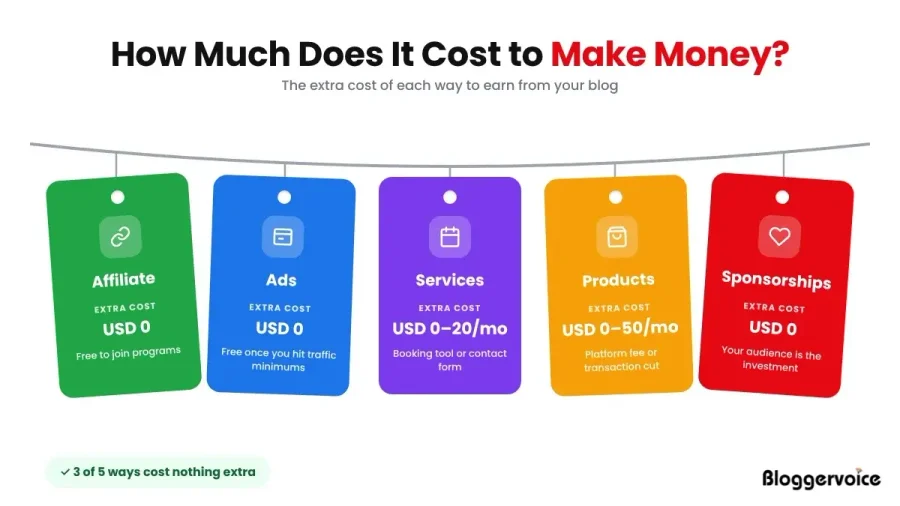
- Affiliate: Cheapest to start. You need content and traffic, plus maybe a link-management plugin. Extra cost is near $0, since programs are free to join.
- Ads: Display ad networks are free to join once you hit their traffic minimums. No real cost beyond the visitors you already need.
- Services: Selling consulting or freelancing off your blog needs a booking tool or contact form, often free to $20 a month.
- Products: Selling a course or template means a platform fee or transaction cut. Plan $0 to $50 a month depending on the tool.
- Sponsorships: Brands pay you directly. Cost is basically your audience and an email address. The main investment is the content that built the audience.
One thing that you can use for free to bring more traffic to your blog is spreading your blog on different sites through article submission sites that actually work in 2026.
When Does a Blog Break Even?
A DIY hobby blog breaks even with its first dollar of income, while a content-heavy affiliate blog can take 6 to 18 months.
Break-even depends on your spend and your model. A DIY hobby blog breaks even the moment it earns a dollar, since costs are tiny.
A content-heavy affiliate blog that spent $3,000 on articles might take 6 to 18 months to earn that back through commissions, since SEO traffic builds slowly.
The honest truth: most blogs take a year or more to pay for themselves, and many never do. Budget as if the money is spent, and treat income as a bonus that compounds.
Is Blogging Still Worth It in 2026?
Yes, blogging is still worth it in 2026, but the bar is higher. AI has flooded the web with thin content, so search engines and readers reward depth, real experience and a clear point of view.
That actually helps careful bloggers, since generic filler no longer competes.
Blogging still costs little to start and can pay off through affiliate income, leads or a personal brand. It rewards patience and quality over volume, which was always the case, just more so now.
What Is My Recommended Blog Budget?
Start at the $100 tier: a domain, a year of budget WordPress hosting, a free theme and your first ten posts written yourself.
This teaches you the craft and keeps risk near zero.
Once you see traffic, reinvest earnings into two or three paid articles a month and one SEO tool. That path keeps your cost of starting a blog low while giving it a real shot at growth. Spend on proof, not hope.
Which Blog Budget Is Right for You?
Choose your budget based on your goal: $0 to test, about $100 to own your blog, about $500 for a side income and $1,000+ for a business.
- Just testing the idea? Use a free platform. Cost: $0.
- Want a professional home you own? Self-host WordPress. Cost: about $100 in year one.
- Building a side income? Add paid content and an email tool. Cost: about $500.
- Running it as a business? Fund content and tools monthly. Cost: $1,000+.
- Design matters more than control? Try Wix or Squarespace. Cost: about $17 to 39 a month.
Conclusion
So, how much does it cost to start a blog? Between nothing and a few hundred dollars for a real one you own.
The three costs that matter are your domain, hosting and platform, and together they run about $50 to 100 in your first year.
Everything past that is content and tools, and those you add only when the blog earns the right. Start small, write consistently, and let results decide when to spend more.
Blogging in 2026 is cheap to begin and hard to master, which is exactly why the people who stick with it still win.
FAQs About the Cost to Start a Blog
Does It Cost Money To Start A Blog?
Not always. A free platform costs nothing but shows ads and gives you a subdomain. A blog you own, with a custom domain, costs about $50 to $100 in year one.
How Much Money Does It Cost To Start A Blog On WordPress?
The WordPress software is free. You pay for hosting (around $3 to $10 a month) and a domain ($0 to $15 year one), so a self-hosted WordPress blog runs roughly $50 to $100 for the first year.
What Is Wix Blog Pricing In 2026?
Wix has a free plan with Wix branding and ads. Paid plans start at $17 a month (Light), then $29 (Core) and about $36 to $39 (Business), billed annually. Business Elite runs $159 a month.
How Much Does A Blog Cost Per Month?
A budget self-hosted blog costs about $3 to $10 a month for hosting. Builder plans run $17 to $39 a month. Add content and tools and a serious blog can run $100+ a month.
What Is The Cheapest Way To Start A Blog?
A free platform like Blogger, Medium, or the WordPress.com free tier. It costs $0, though you trade ownership and a clean web address for the savings.
How much does it cost to run a blog per year?
A solo blog costs about USD 150 to 500 a year to run, covering hosting, a domain and optional tools, before any spending on content.
